

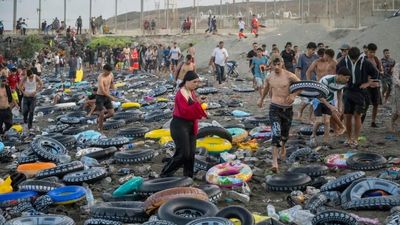
Ceuta, the small Spanish territory on the northern coast of Africa, has returned to the spotlight after an extraordinary wave of migration from Morocco.
Over the last 24 hours, around 49,000 migrants have reportedly entered this Spanish enclave, while at least 18 people have lost their lives while trying to cross the border.
Faced with this massive influx, the Spanish government has taken emergency measures, deploying military forces, strengthening maritime and air patrols, and seeking European Union support for crisis management and border control.
The EU's only land border with Africa

Ceuta, along with Melilla, is one of two Spanish territories located on the African continent. Located on the northern coast of Morocco, it constitutes the European Union's only land border with Africa, making it a strategic point for controlling migration to Europe.
For this reason, for years Ceuta has been one of the main routes used by migrants trying to enter European territory, seeking better living opportunities or fleeing conflicts, insecurity and poverty in their countries of origin.
The territory is protected by an advanced border security system, which includes a double fence about six meters high, equipped with motion sensors and surveillance cameras.
Along the border there is a constant presence of Spanish police and military forces, committed to monitoring and preventing illegal crossings.
How do migrants enter Ceuta?
Migrants are trying to enter the Spanish territory of Ceuta through several different routes and methods. Some of them attempt to cross the border by swimming near barriers from coastal areas of Morocco, while others use small boats to reach the shores of the Spanish enclave.
However, most of the efforts are focused on the border fence, where groups of migrants attempt to overcome it or damage it using metal cutting tools, with the aim of opening a passage to the territory of the European Union.
Despite strong security measures and strict border controls, thousands of migrants continue to try to enter Ceuta every year, while many of them lose their lives during dangerous sea journeys or during mass border crossing attempts.
One of the worst tragedies in recent years occurred in 2022 in Melilla, another Spanish enclave in Africa, where at least 23 migrants lost their lives during a massive clash and crackdown as hundreds of people attempted to cross the border barrier into Spanish territory.
Why does Ceuta belong to Spain?
Ceuta has a long and complex history, spanning thousands of years. Over the centuries, the territory has come under the rule of some of the most important civilizations of the Mediterranean, including the Carthaginians, Greeks, Romans, and Byzantines.
In 1415, Ceuta was conquered by Portugal, marking the beginning of a new period in its history. Later, when Portugal and Spain were united under the same crown in 1580, the administration of Ceuta gradually passed under Spanish control.
After the partition of the crowns in 1640, the city remained under Spanish rule and has remained part of Spanish territory ever since, despite Morocco's continued claims.
Then, with the Treaty of Lisbon of 1688, it was officially recognized as part of Spain, writes the Encyclopædia Britannica .
Since 1995, Ceuta has had the status of an autonomous city within Spain, with a special degree of self-government, similar to that of the Spanish autonomous communities.
Although under Spanish administration for more than five centuries, the status of Ceuta and Melilla remains a contentious issue with Morocco.
Official Rabat does not recognize Spanish sovereignty over these two territories, considering them part of Moroccan territory and calling them occupied territories. Spain, on the other hand, considers Ceuta and Melilla integral parts of its territory.
A constant source of tension between Spain and Morocco
Ceuta has been at the center of diplomatic tensions between Spain and Morocco several times, due to border issues and disputes over its sovereignty.
One of the most severe crises was recorded in 2021, when Moroccan authorities temporarily eased border controls, allowing around 10,000 people to enter Ceuta in just two days.
The sudden influx caused a major humanitarian and security crisis, forcing Spain to deploy its forces to manage the situation and return some of the migrants.
This move was widely seen as diplomatic pressure on Madrid, following Spain's decision to allow medical treatment on its territory for Brahim Ghali, the leader of the Polisario Front, the movement that seeks the independence of Western Sahara and is strongly opposed by Morocco.
Relations between the two countries improved only after Madrid changed its long-standing position regarding Western Sahara and restored cooperation with Moroccan authorities.
Most migrants return to Morocco
Migrants who manage to cross the border and enter Ceuta are in most cases subject to expedited return procedures to Morocco. Some, however, are sent to reception centers, where they have the opportunity to file an asylum application and await the review of their legal status.
Although Ceuta and Melilla are considered symbols of the European Union's external border in Africa, the majority of migrants arriving in Spain do not enter through these enclaves.
The main migration route continues to be the maritime one, especially through the Canary Islands and the Balearic Islands, where thousands of people each year try to reach Spanish territory in small boats.
According to data from Spanish authorities, around 10 million people born abroad live in Spain, with the largest communities originating from Colombia, Venezuela and Morocco.
A significant portion of them is integrated into the labor market and contributes to important sectors of the Spanish economy, especially in agriculture, tourism and services, areas where the demand for labor remains high. /Telegraph/