

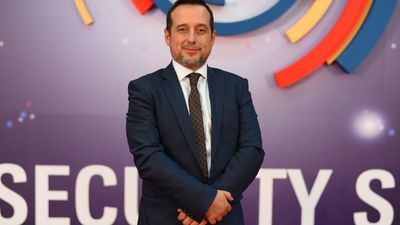
Mahir Hodžić is a security expert with more than 20 years of experience across the public and private sectors. As the owner of Global Security, the publisher of the security trade magazine and online platform a&s Adria, as well as the international media platform a&s Middle East, he plays an active role in informing, educating, and connecting professionals throughout the security industry.
Hodžić chairs the Organizing Committee of the Adria Security Summit, Southeast Europe’s largest security industry event, as well as the Organizing Committee of the newly established Bulgarian Security Summit. Through the media, business, and conference platforms he leads, he has spent the past two decades following the sector’s development, connecting its key stakeholders, and helping bring important questions about the future of security to the forefront.
In this interview, he discusses the changes brought about by artificial intelligence, the practical application of AI solutions, the risks of automated decision-making, the importance of education, and the development of new skills. He also considers how prepared companies and institutions across the region are to use emerging technologies responsibly, as well as the role of the summits in Zagreb and Sofia in further connecting and advancing the regional security industry.

How would you describe the current state of the security industry, and which developments are having the greatest impact on how companies and institutions manage security today?
The security industry is extremely dynamic and evolving virtually every day. Technologies continue to advance, security threats are changing, user expectations are growing, and new regulatory requirements are being introduced. As a result, everyone working in the sector must be prepared to learn continuously, keep pace with emerging trends, and improve their processes. Case studies and the exchange of experience gained through real-world projects are particularly valuable, as they show us what truly works in practice and what needs to change.
The convergence of physical and cybersecurity is particularly evident. It is no longer sufficient to protect facilities, networks, and data separately; risks must be managed through an integrated approach. Cybersecurity has become a key priority for institutions and companies because it is directly linked to business continuity, reputation, user trust, and the effective operation of critical processes.

AI is becoming increasingly integrated into security systems. Where do you see its greatest practical value today?
I see AI’s greatest practical value in its ability to rapidly transform vast amounts of data into actionable insights and alerts. In video surveillance, AI can identify unusual behavior, reduce false alarms, and support the early detection of incidents. In cybersecurity, it accelerates the detection of phishing, intrusion attempts, and anomalies in user behavior.
The automation of routine analysis is particularly important because it gives security professionals more time to assess risks and make informed decisions. AI should therefore not replace people, but enable them to respond faster and with greater precision. Its greatest value lies not only in more advanced technology, but also in enabling a shift from reacting after an incident has occurred to proactively identifying and preventing threats.
Alongside the opportunities it creates, AI also raises certain concerns. What are the greatest risks associated with its use in the security sector, and how can responsible governance, transparency, and human oversight of automated decisions be ensured?
The greatest risks include inaccurate or biased assessments, insufficient transparency regarding how a system reached its conclusion, threats to privacy, and the potential manipulation of both the data and the AI model itself. In the security sector, a single misidentification or uncritical reliance on an automated recommendation can have serious consequences.
AI should therefore be used as a support tool, not as a substitute for responsible human decision-making. Organizations must clearly define where AI is used, what data it operates on, and who is accountable for the outcome. Regular testing, decision logs, independent audits, data protection measures, and mechanisms that allow an authorized individual to stop or override an automated decision are all essential. Particularly when decisions affect people’s rights, safety, or privacy, humans must retain the final say.
How prepared are companies and institutions in the region to use AI as a tool for improving business and security processes, rather than simply viewing it as another technology to purchase?
Readiness varies considerably. Some companies in the region are already using AI successfully for data analysis, video surveillance, automation, and cybersecurity. However, a significant number of organizations still approach it primarily as a technology to be purchased.
Legacy systems, fragmented data, and slower procurement and approval processes pose particular challenges for institutions. As a result, the introduction of AI solutions must be gradual and carefully planned.
AI cannot fix a poorly defined process; it can only repeat its flaws more quickly. The first step is therefore to identify a specific business or security problem, ensure access to high-quality data, assign clear responsibilities, and set measurable objectives. AI should then be tested within a limited process, with the results carefully monitored before its use is expanded.
The organizations best prepared to harness AI will be those that invest simultaneously in technology, employee training, and responsible change management.
What role do education and the development of new skills play in this process? Can AI accelerate professional training while also helping the industry address the shortage of qualified personnel?
Education is essential because technology is now evolving faster than formal education programs can keep pace with. One-time training is no longer sufficient for professionals; continuous development through hands-on training, incident simulations, case studies, and the exchange of experience is essential.
AI can significantly accelerate this process. It can tailor training to an individual’s level of knowledge, create realistic scenarios, support incident analysis, and make technical documentation more accessible. At the same time, by automating routine tasks, it allows experienced professionals to focus on more complex assessments and mentoring younger colleagues.
However, AI will not solve the workforce shortage on its own. It can help alleviate the problem and increase productivity, but it cannot replace human experience, critical thinking, and accountability.
The Adria Security Summit is coming to Zagreb this year, while Sofia will host the inaugural Bulgarian Security Summit. What will these two events bring to the regional security industry, and what role can they play in strengthening its connections and supporting its continued development?
For years, the Adria Security Summit has served as the central gathering place for Southeast Europe’s security industry. By bringing the event to Zagreb, we are continuing its regional mission and bringing together manufacturers, system integrators, distributors, institutions, end users, and professionals from different countries. As one of the region’s most important business and transportation hubs, Zagreb provides an excellent opportunity to connect European Union markets with the countries of Southeast Europe.
The Bulgarian Security Summit represents the next step in the development of this regional ecosystem. Bulgaria has a well-developed market, highly capable specialist companies, and a strategically important geographical position. However, it has lacked a specialized international platform connecting all segments of the security industry. Together with our partner, the National Association of Industrial Security Companies (NAFTSO), we aim to give Bulgarian companies greater international visibility while making it easier for global and regional manufacturers to enter the Bulgarian market.
The value of these two events extends beyond showcasing new products. Their more important role lies in facilitating knowledge exchange, sharing experiences from real-world projects, and fostering dialogue. Through the conference program and B2B meetings, participants can discover new solutions, find business partners, and engage directly with decision-makers—all in one place.
Today’s security threats do not stop at national borders, and the industry’s response cannot remain confined to individual markets. Our goal is for both Summits to be places where participants do more than discuss trends—where they exchange practical experience, forge partnerships, and develop projects that can enhance security across the entire region.
