

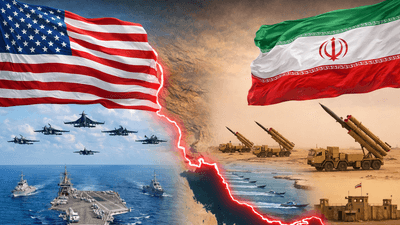
The possibility of a near-term agreement to end the conflict between the US and Iran once again seems unlikely, as the warring parties are exchanging harsh, uncompromising attacks and rhetoric.
The attacks come days after the US announced it was entering a new phase - a broad economic blockade on Iran and countries that trade with it.
The US's aim was to force Iran to negotiate and end its attacks on ships in the Strait of Hormuz, writes the BBC.
This main route for commercial maritime transport has been virtually closed since the start of the conflict between the US, Israel and Iran in February.
A Memorandum of Understanding (MoU), which both sides signed in June and which aimed to lead to a permanent ceasefire and an agreement within 60 days, has now expired.
As the conflict enters its seventh month, we asked three experts for their thoughts on how events might unfold next.
US hopes military and economic pressure will weaken Iran's negotiating power
Jason Campbell, senior fellow at the Middle East Institute, Washington DC

The problem is that we still don't know for sure what the US's strategic objectives in Iran are.
The White House is constantly reassessing what it is willing to compromise on from a political standpoint. It was thought that the military component would be enough for a quick victory, but this has not had the desired effect.
What we are seeing are various means of pressure – both military and economic – that the US is trying to use.
At present, the US administration seems to be content with a sort of status quo. I think it is content with maintaining the blockade and allowing periodic attacks on Iran's capabilities to disrupt shipping in the strait.
US officials hope the new sanctions will be enough to force the Iranian regime to sit at the negotiating table from a weaker position.
US forces appear to have been able to allow limited shipping through the Strait of Hormuz in recent days, enough to avoid a major oil price crash or a global economic collapse. But these were not US objectives when the war began.
My opinion is that Iran is likely to demand a high price to reach a solution, which will most likely remain politically unacceptable to the Trump administration.
Iran will wait for concessions from the US
Dr. Aniseh Bassiri Tabrizi, Associate Fellow in the Middle East and North Africa Program at Chatham House, London

I don't think the recent attacks fundamentally change how Iran views the war.
I think Tehran is preparing for increased pressure on its economy, as well as the continuation of the sporadic attacks that we have seen over the past two months. Their aim will be to respond to these attacks in a proportionate manner, in order to avoid escalating into a wider conflict.
As for the economy, it is clear that this is likely to hit the Iranian economy, which has already been affected by the war and has long faced structural problems, as we saw during the December and January protests in Iran.
But it doesn't seem to me that there is any conviction on the Iranian side that economic pressure will soon change Iran's position, including its stance on negotiations.
This is not to say that Iran is not looking for a way out of the conflict, but I think what we are seeing is that Tehran is waiting for the US to return to the Memorandum of Understanding (MoU), or at least offer some kind of concession.
Tehran does not want to succumb to American pressure nor change its approach in response to sanctions or other attacks.
The US knows what to do – return to the ceasefire agreement
Nicholas Hopton, distinguished fellow for international security at the RUSI think tank in London and former British ambassador to Iran

The latest escalation of military action will not lead to Iran's capitulation – it is simply the latest twist in this conflict. Economic pressure is unlikely to work either, because China, Russia and many other countries that trade with Iran will not support unilateral US sanctions.
Iran can continue to block traffic in the Strait of Hormuz – it has a vital part of the global economy in its hands.
What is the White House's exit strategy from the conflict?
In fact, the US has already found it. If Trump were to commit consistently to negotiating the agreement outlined in the June Memorandum of Understanding (MoU), that would be the way out of the conflict.
Not only would a deal give the US a victory of sorts, as it would weaken radical forces within the Islamic Republic, but it would also assure everyone that Iran would not acquire nuclear weapons.
There is one key element in the MoU: the lifting of all US sanctions on Iran.
The lifting of these sanctions would, over time, weaken Iran’s Islamic Revolutionary Guard Corps (IRGC). Economic engagement between the outside world and Iran in a new form would gradually bring about radical political and social change – resulting in an Islamic regime, but of a very different nature.
Of course, this would not be easy to achieve, given the IRGC's extensive penetration of the Iranian economy. But it should work, given enough time and if the US and its partners show strategic patience, something that is, unfortunately, currently lacking.
For now, I think we will continue to face a messy situation without a clear outcome, which is bad for everyone. /Telegraph/