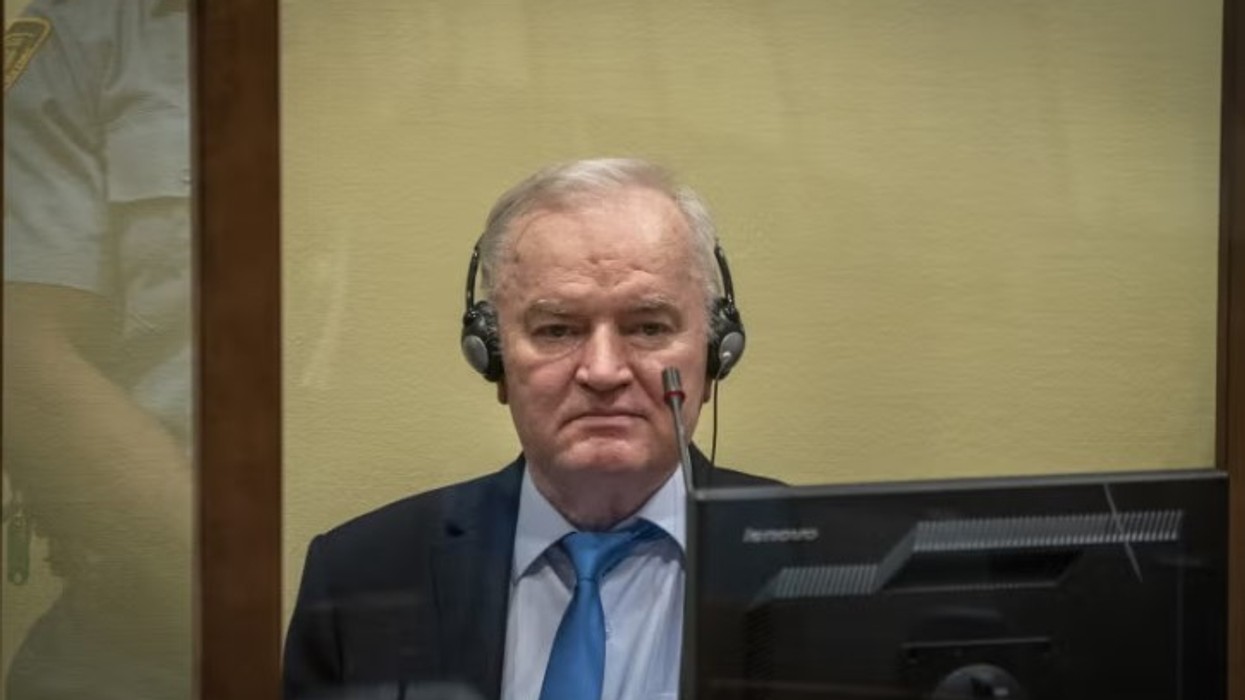
Survivors' groups in Bosnia and Herzegovina have condemned the announcement that the Serbian government plans to bury convicted genocide suspect Ratko Mladic with "the highest military and state honors."
The body of former commander of the Army of Republika Srpska, criminal Ratko Mladic, sentenced to life imprisonment for genocide, crimes against humanity and war crimes, has been returned to Belgrade, while the decision to honor him with military protocol has caused anger in Bosnia and Herzegovina and concern in the European Union.
Mladic died on August 27 in The Hague, aged 84, while serving a life sentence. He was found guilty in 2017 by the International Criminal Tribunal for the former Yugoslavia of his responsibility for crimes committed during the Bosnian war, including the Srebrenica genocide. The verdict was upheld on appeal in 2021.
His body was transported from The Hague to Belgrade on September 3rd on a Serbian government plane. The coffin, draped in the Serbian flag, was received by family members, government officials and members of the Serbian military, and then taken to the Military Medical Academy for an autopsy.
The Serbian government has warned that Mladic could be presented with the "highest state and military honors," a decision that has sparked strong reactions from survivors' groups and victims' families in Bosnia and Herzegovina.
According to reports in Belgrade, a memorial ceremony is planned at the Army House on September 5th, while the burial is expected to take place on September 7th at the Topcider cemetery. However, the final manner of the ceremony and the official participation of the army remain partly unclear.
Mladic was one of the most senior military figures tried by the international tribunal. The court found him responsible for a series of atrocities, including the mass killing of Bosniak men and boys in Srebrenica, as well as crimes committed during the siege of Sarajevo.
Despite international condemnation, Mladic continues to be considered a hero by some Serbian nationalists in Serbia and Republika Srpska. This has prompted strong international criticism and concerns that his glorification could hinder the reconciliation process in the region.
The issue has also affected Serbia's relations with the EU. European Commissioner for Enlargement, Marta Kos, canceled a planned visit to Serbia, criticizing the glorification of a convicted war criminal. The EU has warned that honoring such figures runs counter to European values and reconciliation efforts, which are important for Serbia's accession process to the union.
For survivors' groups in Bosnia and Herzegovina, the Mladic case shows that, although international justice has determined responsibility for war crimes, there is still no common position in the region regarding the past and the crimes committed during the 1992-1995 war. /Telegraph/