
Serbia grants citizenship to Russians sanctioned by US and Ukraine
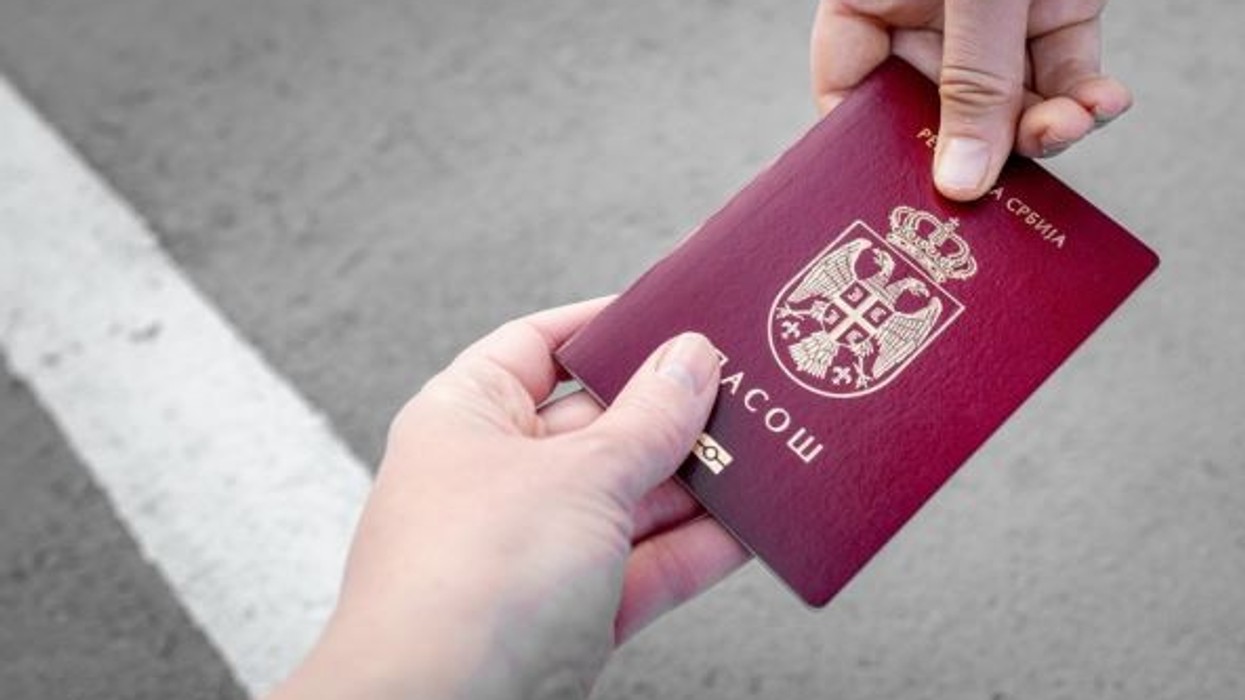
Since the beginning of this year, the Serbian government has granted citizenship to four times more Russian citizens than to all other foreign citizens combined.
Among them are Russians who are under international sanctions, Radio Free Europe/Radio Liberty's (RFE/RL) Balkan Service has found through an analysis of the Serbian Government's decisions.
The Serbian government grants these citizenships, justifying them with "interests" for Serbia.
Valerij Kazikajev has been a citizen of Serbia since January 16.
He has been on the US sanctions list since April 2023, due to business ties to Russian oligarch Alisher Usmanov.
The US State Department has not commented on the Serbian Government's decision to grant him citizenship.
Another new holder of a Serbian passport is Russian citizen Sergey Kondratenko, who obtained citizenship on November 13, 2025.
He is under Ukrainian sanctions for "actions detrimental to national interests and national security."
Another new citizen of Serbia is Igor Kolyushev, a Russian construction engineer in the field of bridges.
He has been under Ukrainian sanctions since 2022.
The Ukrainian Foreign Ministry and the Ukrainian Embassy in Belgrade did not immediately respond to REL's questions regarding granting Serbian citizenship to persons under Ukrainian sanctions.
The Serbian government also did not answer questions about why it is granting citizenship to sanctioned Russian citizens.
The Serbian government has continued the trend of increasingly granting citizenship to Russian citizens, despite warnings from Brussels that this would allow them visa-free entry to the European Union.
This was also highlighted in a recent non-paper by the European Commission, to which REL had access.
This document warns that the accelerated granting of visa-free travel to the EU by Russian citizens through the acquisition of Serbian citizenship — the number of whom has increased — poses a potential security risk to the EU.
"Serbia is not only not imposing sanctions on Russia, but in various ways is bypassing the EU's foreign and security policy," Bojana Selakovic from the non-governmental organization National Convention for the EU told REL.
As a candidate country for membership, Serbia has a visa-free regime with the EU and an obligation to harmonize its foreign policy with it.
However, it has not imposed visas for Russian citizens and has not joined the sanctions that the EU has imposed on Russia due to its invasion of Ukraine.
Who are the sanctioned persons with Serbian passports?
Valery Kazikayev has been placed under US sanctions aimed at "further hindering the import of critical technologies that Russia uses in its war against Ukraine."
These measures were imposed on him in April 2023 due to his business ties with Russian billionaire Alisher Usmanov.
According to data from the US Office of Foreign Assets Control, OFAC, Kazikayev is one of the senior management or board members of companies in the metals and mining sector linked to Usmanov — Metalloinvest and Udokan Copper.
Kazikajev is also the owner of the Slovak company KTH Group Spol SRO. This company is also under US sanctions.
Ukraine imposed sanctions on Kazikayev in November 2023. The measures include asset freezes, a ban on business activity, and a range of other financial restrictions.
REL was unable to contact Valerij Kazikajev.
Oligarch Alisher Usmanov, close to power in the Kremlin, is one of the richest Russians.
He has businesses in the fields of mining, the metals industry, telecommunications, and information technology.
The United States placed Usmanov on its "blacklist" in March 2022.
The justification states that he is close to several senior Russian officials who are under US sanctions, including Russian President Vladimir Putin, as well as Dmitry Medvedev, deputy chairman of Russia's Security Council.
The US Treasury Department also says that Usmanov has at his disposal a network of companies registered in so-called tax havens, through which he can carry out financial transactions - potentially enabling him to circumvent sanctions.
He is also under sanctions by Australia, Canada, the EU, Japan, New Zealand, Switzerland and the United Kingdom.
Sergey Kondratenko, another Russian citizen who recently received a Serbian passport, has been sanctioned by Ukrainian authorities.
Ukrainian authorities have determined that Kondratenko is the ultimate owner of the company Royal Pay Europe, against which Ukraine imposed sanctions in 2023 for "actions detrimental to national interests and national security."
This is shown by data from the Ukrainian branch of the organization Transparency International.
Royal Pay Europe is registered in Latvia, and deals with electronic payments and other financial services.
The State Bureau of Investigation of Ukraine initiated a criminal proceeding against this company in 2023 for the embezzlement of more than 30 million euros, which foreign banks had allocated to one of the Ukrainian commercial banks.
"According to the materials of that investigation, during the fighting in the Kharkiv region, the company attempted to re-register property rights to the real estate of a Ukrainian bank that was in the process of liquidation," Transparency International said.
By a decision of the Supreme Anti-Corruption Court of Ukraine in 2024, the company's assets in that country, worth about $44 million, were confiscated. This money was transferred to the state budget of Ukraine.
During the investigation, Ukrainian security authorities also linked Kondratenko to a Russian betting network.
Sergey Kondratenko did not respond to REL's question, sent to an email address known to the editorial office.
Igor Kolyushev, a Russian bridge construction engineer, has been under Ukrainian sanctions since 2022.
The measures against him are mainly related to the ban on the withdrawal of capital from Ukraine and restrictions on financial flows.
According to data from the National Security and Defense Council of Ukraine, Kolyushev is the technical director of the Giprostroymost Institute in St. Petersburg.
This is one of the leading Russian companies specializing in the design of bridges and transport facilities.
REL was unable to contact Koljushev either.
In April, Yakub Zakriyev, nephew of Chechnya's leader Ramzan Kadyrov, also received Serbian citizenship, but the Serbian government withdrew that decision four days later.
Zakriyev is on the US and UK sanctions list due to his involvement in Russian institutions.
Kadyrov himself is also under US and EU sanctions, and for years has faced accusations of ignoring serious human rights violations, including kidnappings, torture, murder, and persecution of members of the LGBT community.
The Serbian government did not respond to questions about either granting or revoking citizenship for Ramzan Kadyrov's nephew.
In September 2025, the Balkan Investigative Reporting Network (BIRN) reported that at least four Russian citizens had obtained Serbian citizenship by decision of the Serbian Government, despite being under sanctions from the United Kingdom and Canada.
According to these reports, three managers of the Russian energy giant, Gazprom, received Serbian citizenship.
Ruslan Alisultanov, former Deputy Minister of Agriculture of Chechnya and businessman, who today presents himself as a leader in Russia's food industry, also received citizenship.
The investigative portal KRIK and the Russian portal Important Stories reported in April 2025 that among the people to whom the Serbian government had granted citizenship were several Russians connected to the Kremlin's political elite, and to Russia's Federal Security Service, the FSB.
They also reported on people connected to the military industry, people who became rich during the war in Ukraine, and figures connected to other business giants.
For Serbia "interest", for the EU "security risk"
REL's analysis shows that during the first five months of 2026 alone, 44 Russian citizens received Serbian citizenship by decision of the Serbian Government.
From the beginning of 2022 to June of this year, more than 300 Russians have obtained Serbian citizenship.
This was ascertained through a review of the decisions of the Government of Serbia on granting citizenship, published in the Official Gazette.
This is not the final number, because the Ministry of Interior also grants citizenship according to the regular procedure, if certain conditions are met.
The Ministry of Interior did not respond to REL's question about how many Russian citizens have received Serbian citizenship since 2022.
The Serbian government can grant citizenship under a special and expedited legal procedure, which is justified by "interests for Serbia."
However, what for the Serbian authorities represents "interest for Serbia", for the EU is a "potential security challenge".
Serbian citizenship is granted to Russian athletes and artists, as well as businessmen connected to the Kremlin and sanctioned individuals.
The Serbian government did not respond to REL's questions about what it will do regarding Brussels' warnings, nor how it explains the increase in the number of Serbian citizenships granted to Russians.
Marko Todorovic from the non-governmental organization Center for European Policy, CEP, says that Serbia is expected to take into account the interests of the EU when making decisions that affect the security of the Schengen area.
"When the EU, out of caution, is considering how to make it more difficult for Russian citizens to obtain even tourist visas, the tendency in Serbia to grant them citizenship that automatically opens the door to Schengen seems like a move in the completely opposite direction," he told REL.
Several EU member states are pressuring the European Commission to propose a law that would ease the denial of tourist visas to Russian citizens due to the Russian invasion of Ukraine.
According to EU data, the number of tourist visas issued to Russian citizens for the Schengen area increased during 2025 to almost 480,000 — the highest level since the beginning of Russia's invasion of Ukraine in 2022.
How many Russians are there in Serbia?
Thanks to the visa-free regime, thousands of Russian citizens have passed through Serbia since the start of the Russian invasion of Ukraine and the imposition of sanctions against Russia.
Some fled mobilization, others came to continue business with Western countries without hindrance.
According to the latest available data from the Serbian Ministry of Interior, which REL obtained through a request for access to public information in January 2025, just over 48,000 Russian citizens had temporary residence in Serbia.
The Ministry of Interior did not respond to REL's question about how many are currently in Serbia by the time this text was published.
What is Serbia at risk of?
By granting citizenship to sanctioned individuals, according to Marko Todorović from CEP, Serbia is directly jeopardizing its European integration and undermining the community it aims to join.
"This suggests that there is Russian influence in parts of the political and security apparatus, which perform these 'services' in the hope that they will go unnoticed, or even without worrying at all about the possible political consequences," he assesses.
He says that the non-paper is also a signal that the Commission will closely monitor how Serbia implements this process, how detailed the checks are, and whether the background of applicants is actually verified.
Bojana Selakovic from the National Convention for the EU says that the increase in the number of citizenships granted to Russian citizens, including sanctioned individuals, shows that Serbia does not have a clear foreign policy orientation and is maintaining relations with Russia.
"All of this is not in line with a country that wants to become a member of the EU, because the rules there are very strict and very clear," Selakovic said.
Serbia has not opened any new chapters in negotiations with the EU since December 2021, and one of the reasons is the lack of harmonization with the bloc's foreign policy.
At the last EU-Western Balkans summit, in Tivat, Montenegro, Serbia was told that it must decide between Russia and China on one side, and the European Union on the other.
German Chancellor Friedrich Merz said then that Serbia must decide where it belongs, and that "the balance between Russia, China and Europe is unacceptable."
He explained that European leaders had made this clear to Serbian President Aleksandar Vučić. / REL /