


Astronomers have detected for the first time an atmosphere around a rocky planet located in the habitable zone of its star.
It is a "super-Earth" called LHS 1140 b, and this discovery represents an important step in the search for worlds that could be suitable for life. Until now, atmospheres had only been detected on gas giant planets, writes ScienceAlert.
The search for habitable worlds is based on two main criteria: the planet must have a composition similar to Earth and be at a distance from its star that allows for the existence of liquid water, writes sciencealert .
"It's the first time anyone has found an atmosphere on a rocky planet in the habitable zone of another star," said Collin Cherubim, a planetary scientist at Harvard University and lead author of the study published in the journal Science.
Measurements show that LHS 1140 b has a mass about five times that of Earth and a radius 1.7 times that of Earth. This indicates that it is rocky in composition, but its lower density than Earth suggests the presence of a thin atmosphere and possibly some water.

The planet is an ideal object for study, as it is only about 50 light-years from Earth. It orbits a red dwarf star, which is much smaller and cooler than the Sun and has about a fifth of its mass.
"Twenty years ago we wondered whether other terrestrial planets existed at all. Then we discovered that they are common and found some in the habitable zone. The next question was whether any of them had managed to retain an atmosphere. Now we know that at least one of them has," said Robin Wordsworth of Harvard University.
Cherubim had previously predicted that LHS 1140 b might have a helium-rich atmosphere. To do this, he created a computer model that analyzed the processes of planetary mass loss.
The model showed that planets at the right distance from their star could lose hydrogen but retain helium, creating an atmosphere dominated by this gas.
"I call these planets 'helium-rich worlds.' I think they may not be that exotic, but a natural step in the evolution of many small planets. I wanted to test this prediction and looked for helium escaping from the planet – and I found it," Cherubim said.
To confirm the prediction, the researchers used the WINERED spectrograph at the Las Campanas Observatory in the Atacama Desert of Chile.
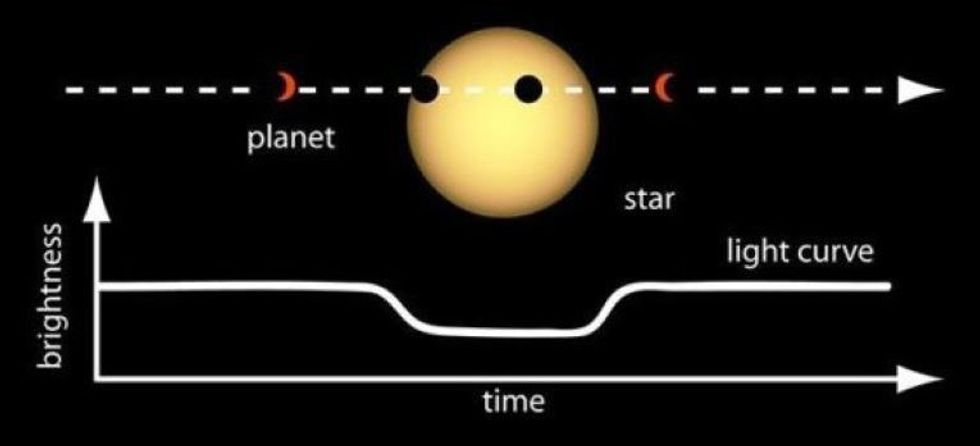
They observed LHS 1140 b and a neighboring planet during a night in September 2024, when both bodies passed in front of their star.
By analyzing light passing through the planet's atmosphere, scientists were able to determine which wavelengths were absorbed by the gases.
They found that LHS 1140 b, unlike its neighboring planet, showed signs of a helium atmosphere that is escaping into space at speeds of hundreds of thousands of kilograms per second.
This process could be caused by the star's solar winds or by magnetic interactions between the planet and the star. However, the phenomenon appears to change over time, as it was not observed during another observation in 2025.

One of the most important aspects of the discovery is the fact that LHS 1140 b has managed to preserve its atmosphere for more than three billion years, even though red dwarfs are known for their unstable activity.
"The planet receives from its star about 42 percent of the energy that Earth receives from the Sun," Cherubim explained.
"Although it has been exposed throughout its history to the highest levels of X-ray and ultraviolet radiation that typically destroy the atmospheres of rocky planets, it has retained some of the helium it probably received during its formation," he claimed.
Scientists will now focus on further analysis to find out if the planet has oceans or other features that could support life.
The fact that this discovery was made with a telescope on Earth shows that ground-based observatories also have an important role in studying atmospheres outside the solar system, alongside space telescopes such as the James Webb Space Telescope (JWST).
"This was a confirmation of the model and I hope it is just the first of many future observations," Cherubim concluded. /Telegraph/