

The truth is that doctors, during the heat of summer and in the sun, usually recommend light, loose-fitting, and light-colored clothing.
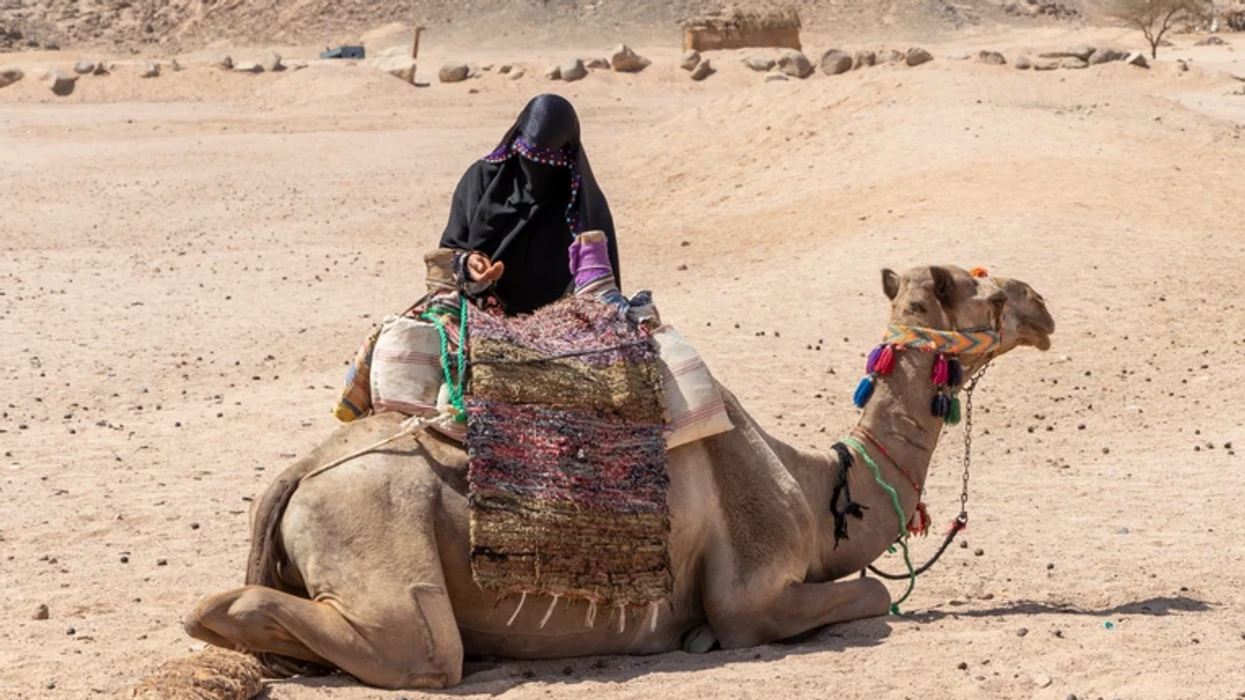
But have you ever wondered why Bedouins, who spend their entire lives in the Sahara sun, often wear black?
The answer to this question is not simple, but neither is it complicated.
The fact is that the color black absorbs solar radiation best, while white reflects it best. Therefore, black is black, and white is white; we see only those colors that are reflected from the surface, not those that are absorbed. The black surface absorbs all colors, so we do not see any reflected, while white reflects everything that our eyes perceive as white. Logic suggests that in the sun it is better to wear white clothes, because they reflect everything.
However, the Bedouins wear black. Do they perhaps mistakenly have an incorrect tradition? Being humans, not animals, it would be possible that they were guided by some "higher" idea that is not necessarily optimal from an evolutionary point of view.
But if we look at the bigger picture, we will understand that this is not the case. For example, the goats raised by the Bedouins, as well as some other desert animals, have black fur, while most Arctic birds have white feathers, although, as science will show, it is not just a matter of camouflage. So where does the secret lie?
Two studies
First of all, we must bear in mind that clothes behave towards our body in a similar way to the sun. In other words, the color black absorbs the thermal radiation of our body better, just as it absorbs the radiation of the sun in the visible and infrared spectrum. In the same way, white reflects the radiation of our body better back towards the skin, just as it reflects the radiation of the sun outside.
Of course, black clothes must somehow release the energy they have absorbed, which is why black also radiates better, he writes.

Black materials radiate absorbed energy primarily in the infrared, thermal part of the spectrum that the human eye cannot see. This is why black cars feel hotter to the touch than white ones, and the coolant in cars is colored black.
This is where our story of Bedouins, goats, and Arctic birds gets a little more complex. As they often say, the devil is in the details.
And these details were revealed very well by a large and detailed study conducted in 1978 (Walsberg, Campbell & King, Comp. Physiol. 126B: 211-222 ), which investigated the influence of different feather colors at different temperatures and in different conditions — white and black, in heat and cold, with flat and "puffed" feathers, as well as without smell and with smell.
Results
In cold, windless conditions, with their feathers spread out, the black birds retained heat better, slightly better than when they raised their feathers upwards. In hot, windless conditions, the puffed-up white feathers reflected and released heat better, protecting against the heat. This supports the intuitive thesis and the recommendations of doctors – in the heat we should wear white and light clothes.
But when the wind picks up, the situation changes abruptly. In winds above 3 m/s, puffed white feathers are less effective at dissipating heat. This explains why most Arctic birds have puffed white feathers. Whereas puffed black feathers in these conditions are better at dissipating heat, which explains why Bedouins wear loose, black clothes, and why their goats have black fur.
Why does this happen? Black clothes absorb both types of radiation – both solar and our body radiation. However, if the clothes are loose and “untidy” (e.g. made of wool), i.e. not clinging to the body, and if there is wind, the air flow removes heat faster than it is absorbed and transmitted to the skin. On the other hand, a black T-shirt clinging to the body in the sun without wind is the worst solution for heat.
The key is whether the clothes are loose.
Another study, published in the journal Nature in 1980, which aimed to answer the question about the Bedouins in black, yielded similar results. It showed that people dressed in loose black clothing warmed up almost as much as those dressed in white.
In fact, although the surface of the black cloth absorbed about 2.5 times more heat, it seems that this heat did not easily reach the body, while the body was cooled through the spaces and ventilation of the loose clothes. Furthermore, Bedouins often travel covered in white, while in the shade of their tents they often wear black.
What do we conclude from all this? In most cases, in the conditions we live in – on city streets in the summer, where there is usually no wind at all – it is still better to follow the advice of doctors: to wear white, light and loose clothes. /Telegraph/
- YouTube www.youtube.com