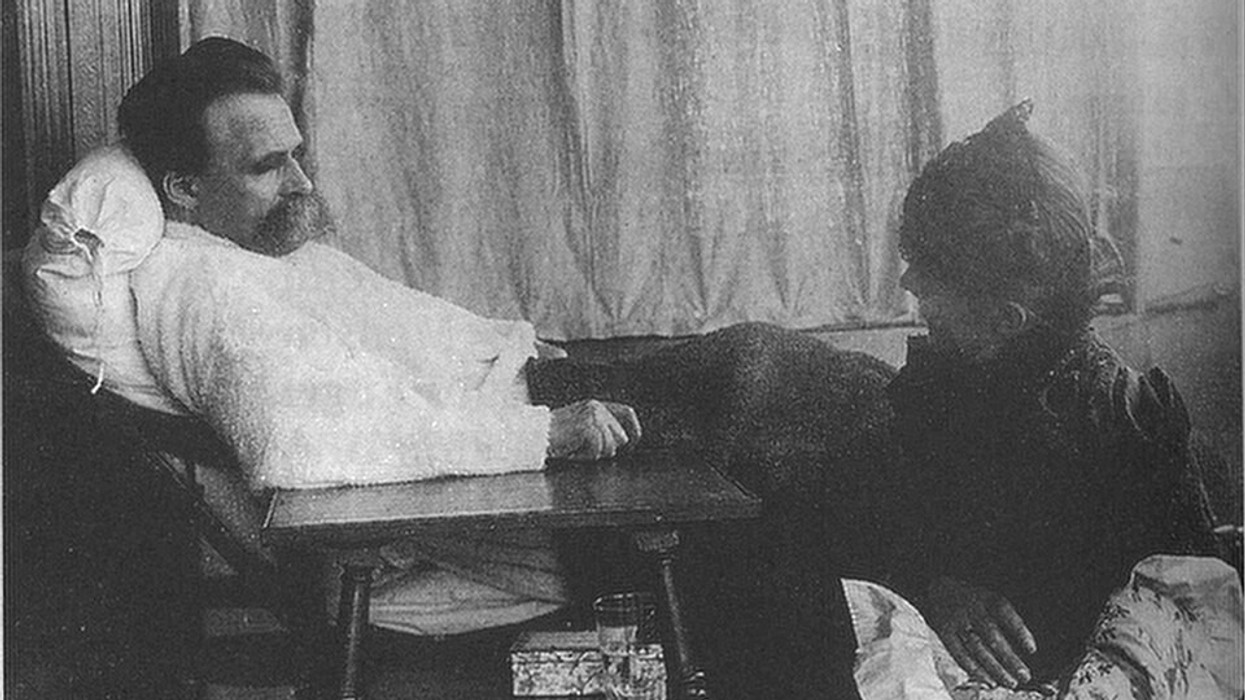
Nietzsche judged anyone who offered “answers” or “comfort” – but engaging with nihilism can teach us to confront the discomfort of a potentially meaningless existence.
By: Gemma Parker, author of the book Mom is worried and doesn't know why. [The Mother is Restless and She Doesn't Know Why] / The Guardian (title: Move over stoics! Why we should all embrace nihilism - and discover what really matters in life)
Translation: Telegrafi.com
A trick I developed in the latter stages of my first pregnancy to avoid questions, concerns, recommendations, and advice about having a baby was to refer to her impending birth as “the apocalypse.”
"I don't know," I shrugged. "We'll see what things look like after the apocalypse."
It was an effective strategy—after all, there's not much advice you can give a woman who's clearly planning to lead; motherhood as the aftermath of a nuclear explosion. I was skeptical, even cynical, about what the world insisted was vital to the life of my unborn child. It was partly skepticism, because much of the advice I was getting was contradictory. But I was also skeptical, because I'd spent most of my twenties reading Nietzsche.
Nietzsche may not be the most natural choice for a new mother. But he helps to feed some of the questions about values and purpose that are central to questions of care. I found myself returning to him again, years later, when both of my children were in elementary school. I wanted help navigating the tension between the deep responsibilities we have to those we love and are obligated to care for, and a burning desire for freedom, adventure, and new experiences.
Nietzsche, and nihilism, are not natural places to look for answers to these kinds of questions. I know that. Nihilism is known as the philosophy where “nothing matters” - it is associated with anarchy, hedonism and those stale things in [the film] The Big Lebowski [The Big Lebowski]. But in Nietzsche, nihilism does not function as a shortcut to avoid responsibility, or as a ticket to hedonistic self-indulgence. Nihilism functions first as a diagnosis, then as a confrontation, then as an incentive. It what Nietzsche offers is a way of asking what exactly matters - and what if what matters is very, very different from what we have been brought up to believe matters.
If we accept that this is true - that what really matters may be different from what we thought mattered - how can we find what really matters? What might allow us to step outside ourselves and our social conditioning to gain the perspective necessary to determine our sense of value, purpose, and meaning in life - if that is even possible?
Nietzsche is harsh in his condemnation of anyone who offers “answers,” “comfort,” or “escape.” He is brutal in his indictment of organized religion and contemptuous of contemporary philosophers who claim to have “solved” the riddle of life. He does not subscribe to belief systems, easy answers, or lazy escapism. A reader who goes to Nietzsche with questions comes back with only more questions. Once you embark on this journey, you may find that you can no longer believe in any objective truth, purpose, or meaningful existence.
And, so, the next question naturally becomes: how do you cope with that discomfort? How do you stay in that despair, without giving up, or giving in? Is it possible to pursue joy, good health, connection, love, and purpose without falling into a negative spiral of cynicism, pessimism, and skepticism? Can we be skeptical, pessimistic, cynical, even nihilistic, and yet get up and prepare lunch for school, laugh at our children's stories about the substitute teacher, visit our mother in the hospital and comb her hair?
Since I was particularly interested in the idea of art as a response to nihilistic thought, I read the works of many artists who were interested in nihilism, including Samuel Beckett and Albert Camus, who grappled with these questions in their lives and literature. But I often found myself thinking about Dolly Parton, and the story of one night when she wrote not one, but dy hit song. She had gained a lot of weight, she said, and was on a liquid diet. The liquid protein was slandered and she had to drink it three times a day. One night, she was at a hotel that had “those wonderful fried mussels” that she really liked:
The band was downstairs in the restaurant. I could hear them laughing and talking. I was in my room because I couldn't go down there to eat. I remember feeling so bad for myself in that lonely room while they were partying. I thought, "Well, I can't eat. I can't sit here feeling sorry for myself. Why don't I write a song?"
Parton is not a nihilist, but if nihilism is believing that life is a “lonely room,” and if we come to believe that “we can’t just sit here feeling sorry for ourselves,” there’s something refreshing about her simple, playful refusal to wallow in that despair and create something new.
Engaging in nihilistic thought experiments doesn't necessarily mean wandering around feeling tortured and writing poems about the futility of life. For me, it means making a daily commitment to have the courage to question what is proclaimed as meaningful, to try to face the discomfort of a potentially meaningless existence, and to keep showing up, and creating things, despite the discomfort and despair.
Nihilism is boring if thought stops at the point where we accept that life has no meaning. I'm interested in the next point. What do we do in the face of despair. What do we create, even if nothing we create matters. What do we do, even if nothing we do matters. /Telegraph/