

The European Commission, in its 2025 Progress Report on Kosovo, has raised concerns about threats to journalists, the lack of media independence, and the crisis in the functioning of the public broadcaster RTK, emphasizing that freedom of expression in the country has remained without progress.
"Kosovo has a certain level of preparation, but has not made progress on freedom of expression. The media landscape is pluralistic, but faces problems related to transparency of ownership and financial sustainability of the media," the report says.
During the reporting period, 70 cases of physical, verbal attacks or threats against journalists were recorded, including obstruction of their work, use of offensive language and one case of strategic lawsuit against public participation (SLAPP).
“During the election campaign, senior Kosovo officials, including the Prime Minister, used offensive language towards the media,” the report states.

The Commission considers this a worrying practice that undermines the security climate and freedom of expression in the country.
According to the report, the legal framework regulating the media “needs to be harmonized with new EU standards and relevant international acts,” including the European Media Freedom Act and the EU Anti-SLAPP Directive.
The Law on Radio Television of Kosovo and the Law on the Protection of Journalistic Sources are still awaiting approval, while the 2008 Law on Civil Defamation needs to be updated to align with the jurisprudence of the European Court of Human Rights.
Meanwhile, the report mentions that the Law on the Independent Media Commission (IMC) has been repealed by the Constitutional Court, after the provisions on the appointment and dismissal of members were deemed unconstitutional, threatening the independence of this institution.
“It is essential that the law is fully harmonized with EU and international standards,” the report emphasizes.
The Commission emphasizes that Radio Television of Kosovo (RTK) continues to face a lack of financial independence and serious structural problems.
"There has been no progress in finding a sustainable, long-term and independent financing model for the public broadcaster," the report notes.
The report adds that the position of RTK's general director has been vacant since September 2024, while the RTK Board has been without a quorum since December 2024, rendering the public broadcaster "dysfunctional and unable to fulfill its role effectively."
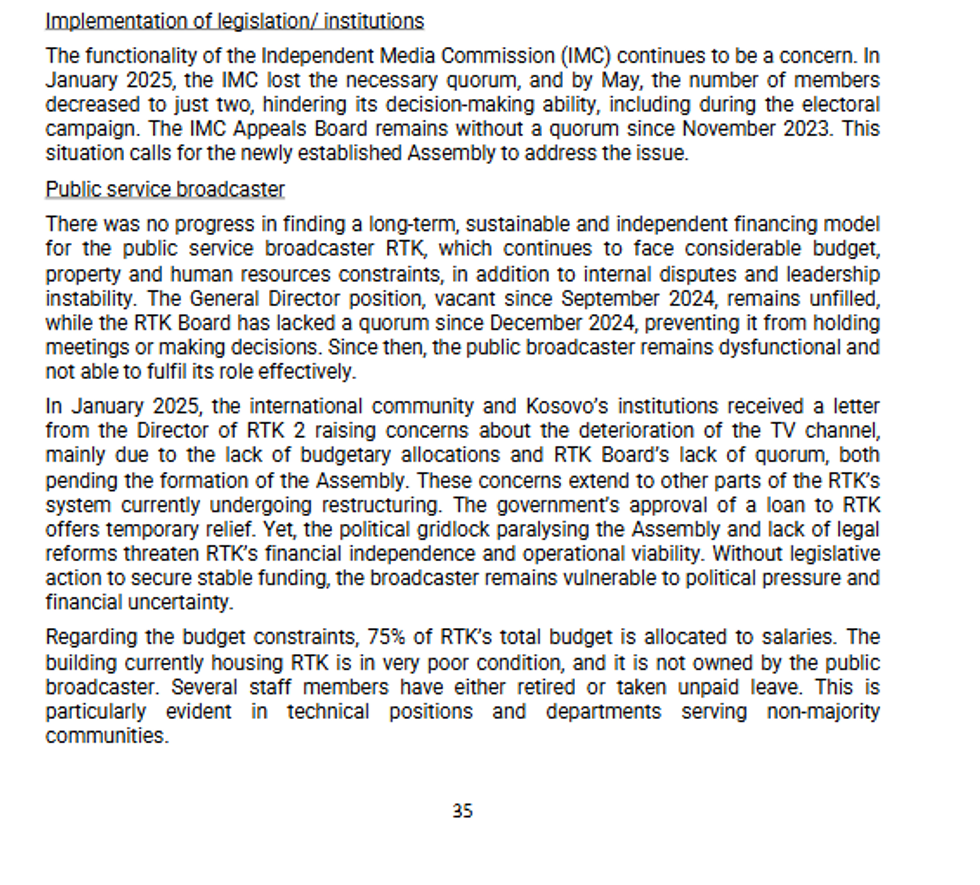
In January 2025, the director of RTK2 sent a letter to Kosovo institutions and the international community, warning of “the worsening condition of the channel due to the lack of budget and the dysfunction of the board.”
The report further emphasizes that 75% of RTK's budget goes to salaries, while the building where the institution is located is in very poor condition and is not owned by the public broadcaster.
“The political deadlock paralyzing the Assembly and the lack of legal reforms threaten the financial independence and functioning of RTK,” the report warns.
The media sector in Kosovo, according to the European Commission, "suffers from a lack of transparency in media ownership and financing."
The current register only includes licensed radio and television stations, while data on ultimate owners and market share “are not available.”
"Combined with a lack of financial sustainability, this makes the sector either dependent on foreign donors or vulnerable to political influence and financial pressure," the report states.
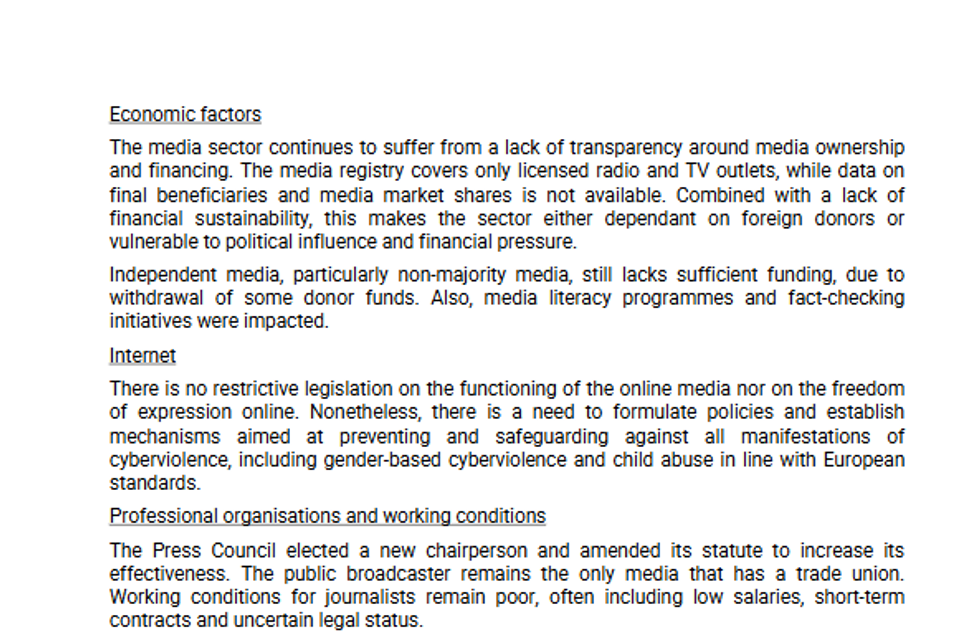
The Commission further adds that independent media, especially those of non-majority communities, still lack sufficient funding.
Regarding working conditions and professional security, the report highlights that working conditions for journalists remain poor, with low salaries, short-term contracts and uncertain legal status.
The Council of the Written Media has elected a new chairman and amended its statute to increase its efficiency, while the public broadcaster remains the only syndicated media outlet. /Telegrafi/