

"Don't judge, hit Bondsteel" or "Here's another American base! Thanks in advance," are some of the comments circulating on Telegram channels and other social networks since February 28, when the United States and Israel launched attacks against Iran.
Camp Bondsteel, located near Ferizaj in Kosovo, is the largest American military base in the Balkans.
In some Telegram groups, which have from 10.000 to over 80.000 followers, maps with the location of Bondsteel marked are also published, accompanied by comments such as "This is the biggest threat to Iran right now", or maps of the range of Iranian ballistic missiles with a focus on Kosovo, with the description "Just do it".
One of the most visited far-right channels in Serbia on Telegram, "Bunt je stanje duha", on March 1 also published the coordinates of the Bondsteel camp in Kosovo with the text: "They say that we are those extremists and that we should be ashamed that we want to see Bondsteel in flames."
This post had almost 18.000 views by the time the text was published.
Otherwise, most of the Serbian-language Telegram channels were created after the Russian invasion of Ukraine in February 2022, while the posts are clearly pro-Russian, sharply criticizing any cooperation with Western countries.
In the last three days, they have also been following developments in the Middle East in real time.
What is happening in the Middle East?
The US and Israel on February 28 launched an operation against important targets in Iran, including Iranian military facilities and residences of the country's top officials.
The operation, which followed weeks of tension and a rapid buildup of US military forces, killed Iran's supreme leader, Ayatollah Ali Khamenei. US President Donald Trump also said that 48 Iranian leaders were killed in the attacks and that the attacks could last four weeks.
On the other hand, Iran launched attacks on American and Western military facilities as well as civilian locations in Israel, the Persian Gulf, and other countries, while Israel responded with attacks on Hezbollah positions in Lebanon.
Meanwhile, the administrators of the “Koridor” channel, which has 11.000 followers, emphasized in a post on Telegram that they will not “broadcast news about this war unless there is some significant news, such as Bondsteel being hit, because, simply put, both sides have killed Serbs, so we wholeheartedly wish for both sides to disappear.”
Earlier, this channel also published the coordinates of the Bondsteel camp with the description: "Coordinates for the Iranians, this is where [Israeli Prime Minister Benjamin] Netanyahu and all your enemies live."
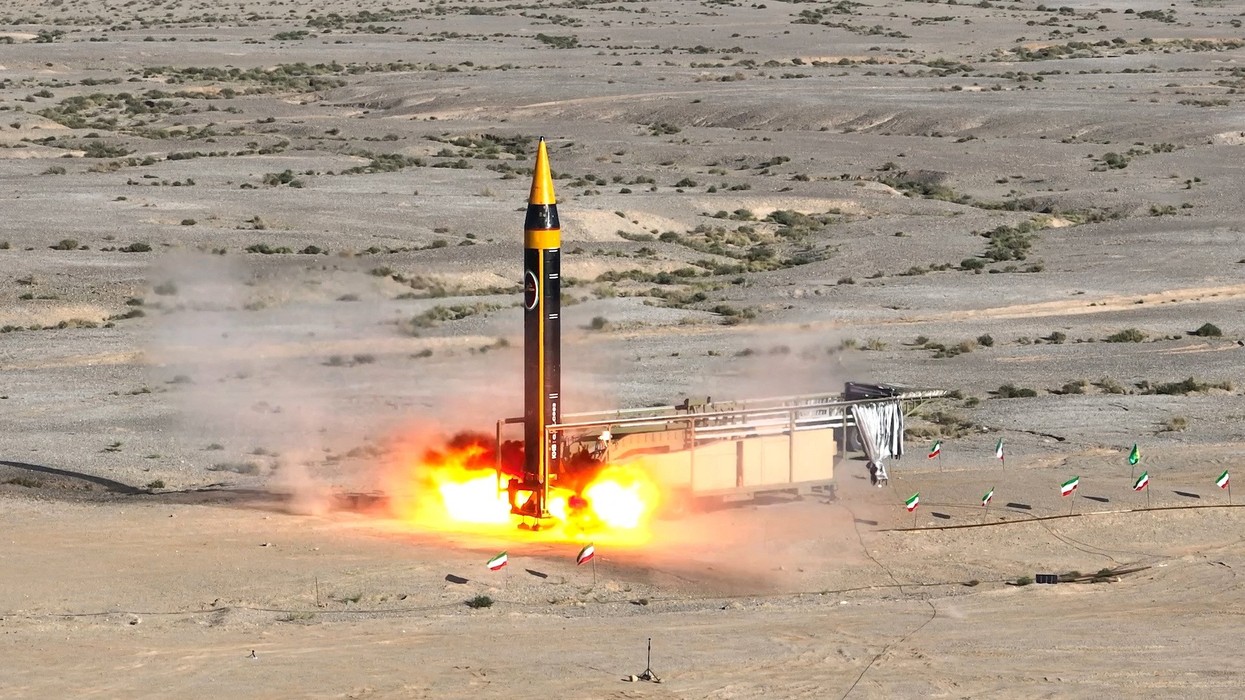
On Sunday evening, the same coordinates were shared again, along with a photo of the Iranian ballistic missile range and the comment: "You can't reach it, can you? Come on, let's see."
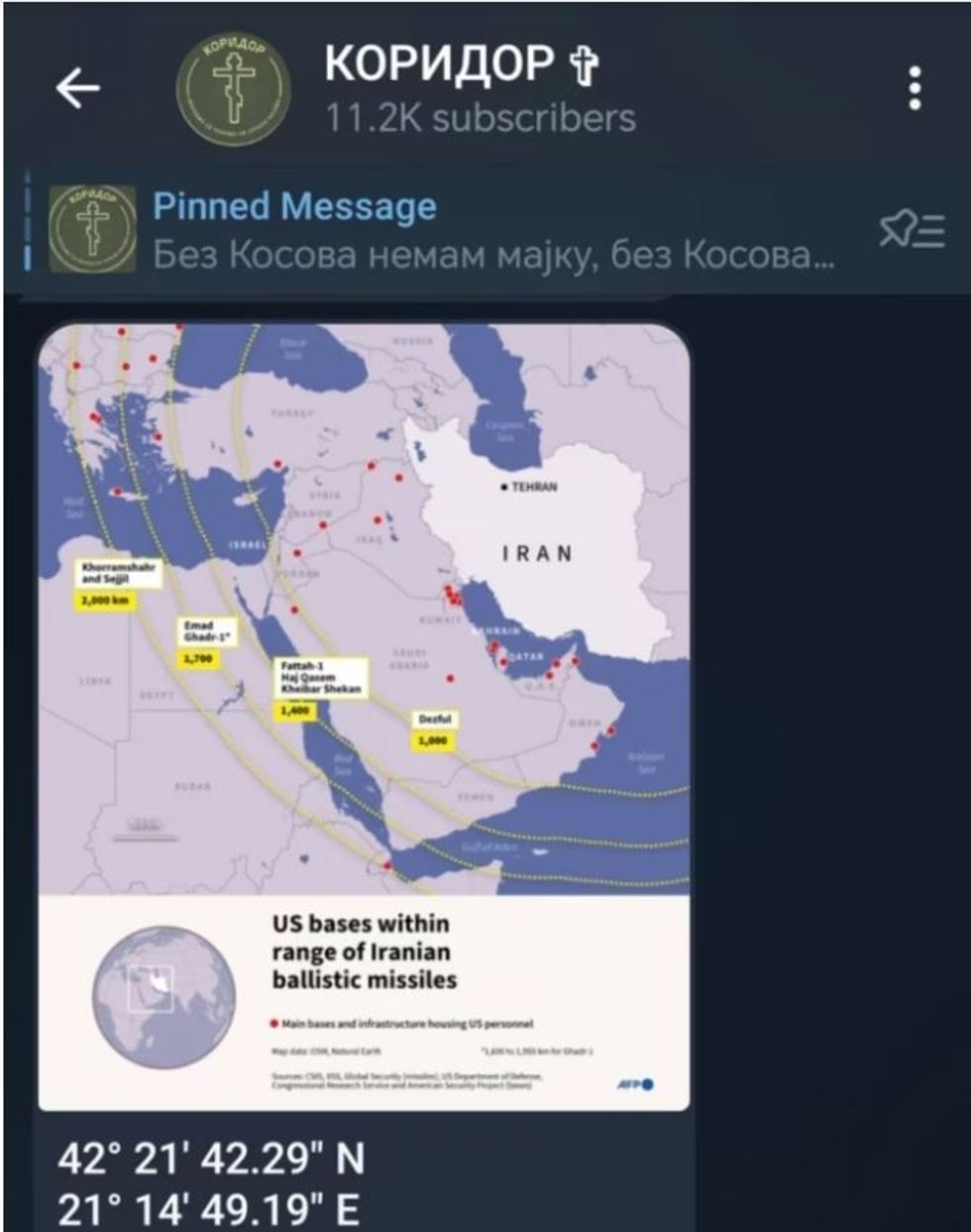
The Telegram channel "Koridor" was previously used by the "Sever Brigade", which, together with the Civil Protection, was declared an organization. terrorist by the Government of Kosovo in June 2023.
The same coordinates of the Bondsteel camp or calls for its bombing have also been published by other right-wing pro-Russian channels, such as “Сербский Вестник”, Srpska Sparta Info and Bunker. Together, they have over 50.000 followers.
In addition to Telegram, the coordinates of the American military base in Kosovo have also been shared on the social networks Facebook and X. Thus, the post has also ended up in the group "Serbi i Rusi, braća zauvek", which has around 30.000 followers, as well as in the group "Pravoslavni manastiri i crkve", which is followed by 70.000 people.
Otherwise, for most right-wing and pro-Russian channels, Kosovo is a common theme – namely the narrative of delegitimizing Kosovo's institutions, denying Kosovo's independence, and promoting radical rhetoric such as calls for military intervention.
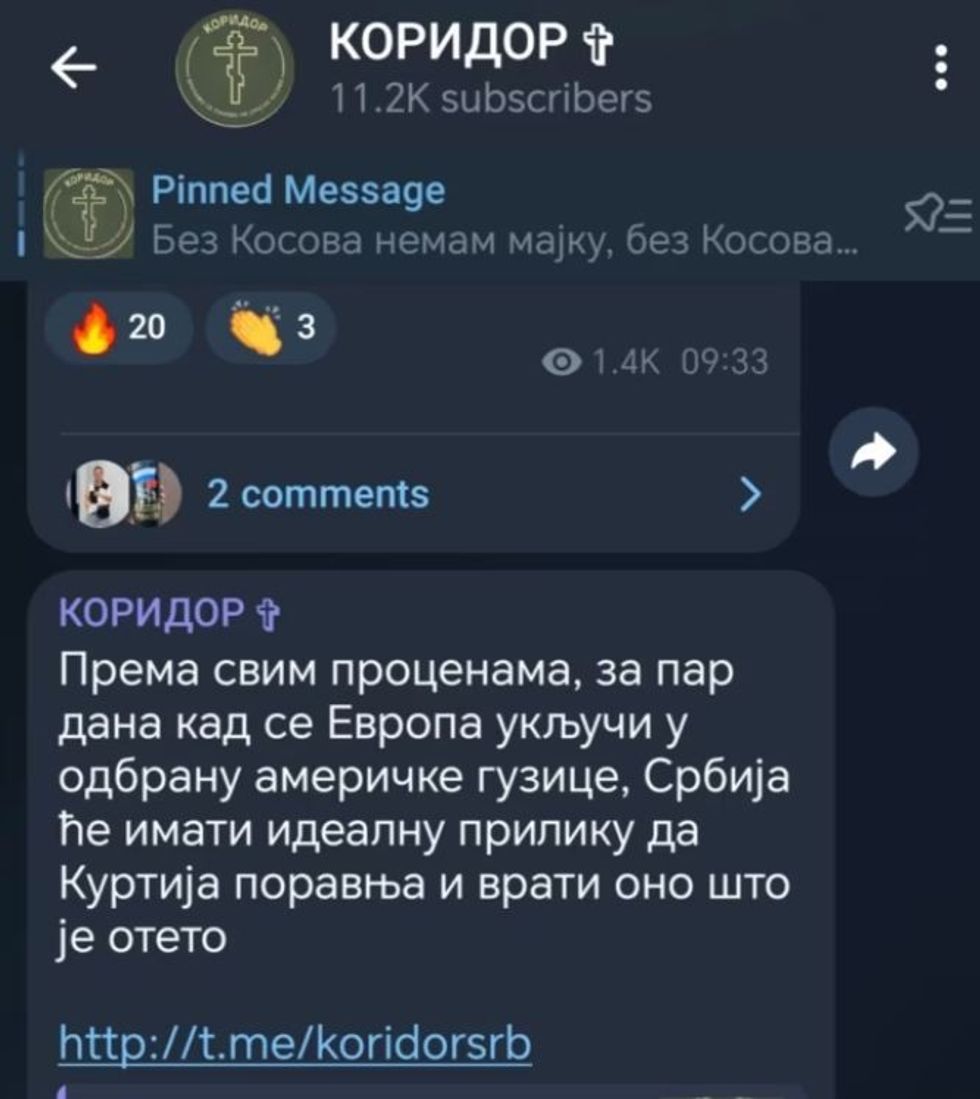
So, in the last three days, in addition to calls for the bombing of Bondsteel, messages can also be seen that "the opportunity must be seized and what was taken by force must be returned."
Jeta Loshaj, a researcher at the Kosovo Center for Security Studies, who also follows the flow of disinformation on Telegram channels, says that the posts of recent days do not pose a real threat from a military and technical point of view, as Iran does not have weapons with long enough range to target Kosovo or wider parts of Europe.
However, she points out that the orchestrated calls for the Bondsteel bombing fit the “now-familiar pattern of disinformation amplification.”
"Pro-Russian networks typically exploit moments of heightened geopolitical tensions, such as the recent escalation involving the US, Israel and Iran, to spread alarming but unverified claims. The Western Balkans, while not the central arena of these conflicts, remains a sensitive and politically fragile region. For this reason, it often becomes the subject of narratives that aim to incite anxiety, deepen divisions within communities and undermine trust in security institutions," Loshaj tells Radio Free Europe.
She adds that the impact of such messages is psychological and political.
"The deliberate distribution of coordinates and dramatic framing of messages are intended to incite concern and reinforce the perception of instability in this part of Europe," she adds.
However, she emphasizes that chain postings on Telegram channels should not be completely neglected.
"For this reason, in coordination with KFOR, Kosovo institutions should regularly assess potential vulnerability, including considering strengthening defense capacities in the long term. Kosovo currently does not possess its own air defense systems and, although there is no immediate threat, strategic planning of future defense capacities constitutes a legitimate reason to start thinking about this now," says Loshaj.
Earlier, Ivana Stradner, a fellow at the non-governmental Foundation for Defense of Democracies in Washington, in a statement to Radio Free Europe, assessed that the consequences of the radical pro-Russian narrative on Telegram channels are already visible in the Western Balkan countries, as for years they have been actively spreading anti-Western propaganda, polarizing societies.
As an example, she mentioned that a large number of Serbian citizens are against the EU, even though it is the EU that provides great assistance to that country.
She also emphasized that pro-Russian Telegram channels across the region play an important role not only because of the number of followers, but also because they serve as "entry nodes into the information space."