

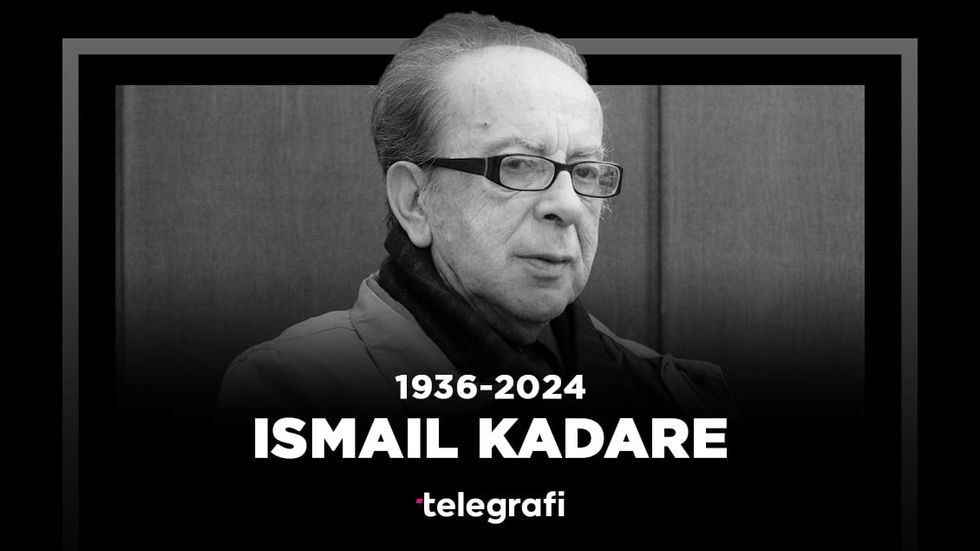
This Monday, July 1, 2024, the well-known writer Ismail Kadare passed away.
Kadare was one of the greatest contemporary writers. As a writer, he stands out mainly for prose, but his contribution also extends to dramaturgy, poetry and translations.
Kadare started writing when he was still young, first poetry, with which he became known, and then prose, becoming the main Albanian prose writer. Until today, his works have been translated into about 45 different languages, thus being the main representative of Albanian literature around the world.
In 1996 Kadare became a permanent member of the Academy of Moral and Political Sciences in France. He has been honored with many international prizes, including the Man Booker International Prize in 2005, the Princess of Asturias Prize for the Arts in 2009 and the Jerusalem Prize in 2015. In recent years, he divides his time between France and Albania. .
Kadare was born on January 28, 1936 in the Palorto neighborhood of Gjirokastra, in a Bektashi citizen family, the son of Hali Kadare and Hatixe from Dobatët, thus having from his mother the bejtji Hoxhë Dobi. The name was given to him in memory and honor of his grandfather; the couple had two more children, Kadrije (1937-2022) and Shahini (1943-2021). As a child, he spent a lot of time in the library of his maternal grandfather, who was a judge educated in Istanbul. His father worked as a postman of the city court, in 1920 he was among the 218 volunteers from Gjirokastria who participated in the War of Vlora.
When the communist regime was established in Albania, he was only 8 years old. He finished primary and secondary school in Gjirokastër. At the age of 12, he was arrested under the charge of "forgery of coins", since during the game with his friend they had created 5-lek coins with molten lead and had happily shown them to everyone. The police arrested them during the lesson at school, two days before the voting day, and Ismaili spent two days in prison until the Kadaren's lawyer intervened and they released him due to his minor age.
When he was 13 he discovered Shakespeare's Macbeth, and thus his love for literature was born. At this age he wrote his first stories which he published in the magazine "Pioneri" in Tirana. At the age of 17 he wrote two poems about Stalin, which Malcolm says helped lead to the publication of his first book at the age of 18, a poetry collection entitled Boyish Inspirations.
He completed his university studies in Tirana, where he lived at his aunt's house and after inviting her, he lived with Nasho Jorgaq for almost two years (1957-58). In 1958, he graduated from the Department of Language and Literature at the University of Tirana and graduated as a Teacher. He wrote his first novel, Mjegullat e Tirana, which he finished on the eve of continuing his studies in the Soviet Union. In the years 1958-1960, he studied in Moscow, at the "Maxim Gorky" Institute of World Literature, during the period of Khrushchev's appeasement. There he had the opportunity to read contemporary Western literature, which had begun to be translated into Russian.[30] At the Gorky Institute, he decided to reject the canons of socialist realism and write the opposite of what communist dogma called "good" literature. He was forced to abandon his studies due to the breakdown of relations between Albania and the Soviet Union. He returned to his homeland where he started working as a journalist and learned the literary career, but also as an editor of the foreign literature section in the literary magazine "Drita".
The 60s
Throughout the 50s and early 60s, he was known for his poetry, and starting from the 60s for his prose. In that period, most of the writers belonged to the post-war generation. The conflict between them and the new generation, Kadare, Agolli and Arapi culminated in a meeting of writers of both generations in 1961, where Enveri himself was present. Kadare, who belonged to the young generation, defended the new literature, and surprisingly, Hoxha here took the side of the young. This maneuver of Hoxha was also a blow to the old generation, former partisans, and turned the new generation into the new cultural nomenclature.
After returning from Moscow, he was advised to keep the work City Without Ads hidden. He detached a fragment from this novel, which was published as a novel with the title Cafe Days in 1962 in "Voice of Youth". As soon as it came out of the press it was banned, as a decadent work. In 1963, he published the novel The General of the Dead Army, which dealt with the theme of an Italian general and a priest who come to Albania to collect the remains of Italian soldiers who died in the Second World War. The subsequent novel, Monster, was published in the magazine "November", but was banned.
In the preparations for the Albanian Cultural Revolution, like other writers and intellectuals, he vowed to go to the countryside with creative leave. Kadare was sent to Berat where he stayed for two years as a correspondent for the newspaper "Drita", where he got to know the workers of the textile factory. He was tasked with getting to know the textile factory workers; using a story that had been published in the early 60's entitled The Strange Wedding and in recognition of the reality of life, the drum skin fund took shape, which was published in the spring of 1967 in the magazine "November".
In 1967, he was assigned to the delegation of the League of Writers that was sent to China, along with several other delegations. At that time the Cultural Revolution in China was at its height. He would deal with his experiences in communist China later in his work. After China, Kadare's delegation stayed two weeks in Vietnam, where the war continued. On the last day, when they were crossing the Mekong River in a large raft, they were bombarded between the river.
70s, international success Chronicle in stone, 1971
At the beginning of 1970, the French publishing house Albin Michel published the novel The General of the Dead Army in French. It had a tremendous impact in France and was translated into almost 20 languages within three years. Then he returned to historical topics. He wrote and published the novels Castle (1970) and Chronicle in stone (1971), which were published in France one after the other. During these years, he also managed the only foreign language magazine of the League of Writers, "Les Lettres albanaises". After his success in France, he was appointed deputy, and after two years he joined the Labor Party of Albania.
After the publication of two novels with a historical theme, Kadare again faced criticism for avoiding "current" themes, so he thought of writing a novel on the theme of the breakdown of Albania with other communist countries in the winter of 1960-1961, so that he had free hands to return to Albanian history and legends, for which he was criticized for neglecting the New Albania. He gave the novel the title Winter of Great Solitude. Once released in early 1973, to critical acclaim, it was revised and republished in 1977 under the changed title The Great Winter and also translated into French.
The 80s
In the fall of 1980, he visited Kosovo on the occasion of the first publication of his works in Pristina. He was received institutionally and had numerous meetings with readers and intellectuals of Kosovo and became familiar with the preoccupations of Albanians.
On December 17, 1981, the prime minister of Albania, Mehmet Shehu, was found dead, then declared a traitor and poly-agent. The day before Shehu's funeral, writers and artists were invited to an art exhibition where Enver Hoxha himself would participate, but Kadare was not invited. In the same autumn, he submitted for publication the novel Concerti, in whose pages he mentions the way in which the Chinese dictator Mao Zedong eliminated his deputy Lin Biao, presenting it as an air accident. In January 1982, the windows of Kadare's house were broken with stones, while rallies were organized in front of the house shouting "Kadare, agent of the bourgeoisie, agent of Mehmet Shehu."
In the years 1981-1982 the situation became honorable, also because of the testimonies given to the investigator by the family members and associates of the prime minister who was found dead, Kadare was being accused of sabotaging the Party in literature, art, culture and being a member of the group of Shehut. In a secret meeting in September 1982, Hoxha mentions him as part of a group of Lubonja and Paçram.
Accusations of being Shehu's collaborator and the content of the novel Palace of Dreams, which was about to be condemned, but escaped arrest due to international recognition. In an article in the French magazine Lire, Bernard Pivot wrote that France was worried about the fact that Kadare was not responding to the invitation to go to Paris, writing "We are waiting for Ismail Kadare and not his head on a plate...". In 1983, he was allowed to respond to the French invitation and visit France without his family while his wife and daughters were kept in Albania as a means of pressure.
The next novel, Night with the Moon, published in early 1985, was banned. The day after the dictator's death, on April 10, members of the League of Writers, the Politburo and the Central Committee of the Communist Party hastily organized a meeting to condemn his latest novel.
The Fall of Communism (1989-1991)
In 1989, the authorities appointed him vice-chairman of the Democratic Front. Using his fame in Albania and abroad, he made more and more vocal statements about the necessity of changes, especially in the field of human rights. In the preface to Neshat Tozaj's bold novel Thikat (1989) denouncing the violations of Sigurimi, Kadare asserted that only by acknowledging and correcting past mistakes could Albania move forward. In February 1990, Kadare requested a meeting with Ramiz Ali where he asked him to respect human rights, implement democratic reforms, economic reforms and open up to the outside world.
At the end of October 1990 he was allowed to leave for treatment in France according to one source, according to another he left with a regular visa for his whole family. His escape was welcomed by those who wanted the democratization of Albania, but after his escape he was declared a traitor and Ramiz Alia demanded his criminal prosecution. ATSH declared: "Kadare deserted!" Some intellectuals, despite the danger that threatened them, publicly supported Kadare, whom the authorities had declared a traitor. Because of his popularity, the authorities did not find enough support against him and his books were not banned. A few days after Kadare's escape, at a national conference of writers and young artists in Korça, attended by hundreds, the name of the writer was greeted with cheers, whose escape had made it forbidden to mention his name.
In transition
After leaving Tirana and applying for political asylum in France, he was able to practice his profession in complete freedom. His exile in Paris was fruitful and allowed him further success, both in Albanian and in French.
After the victory of the Democratic Party in 1992, Kadare returned to Albania. From 1990 onwards, his work became the most powerful expression of the linguistic and artistic values of literary Albanian, both inside and outside the country. Ismail Kadare's literature after 1990 carries the same essential features of the previous one: the ethnographic spirit and the manifestation of the Albanian identity, adding the author's freedom to address topics that could not be addressed freely before.
In 1996, he was admitted to the Academy of Social and Political Sciences in France, where he replaced the philosopher Karl Popper. From 1994 to 2004, the French publishing house Fayard published Kadare's complete works in French and Albanian. During the 90s, he helped the publication of many Albanian authors in France, either by suggesting them to French publishers, or by writing their forewords. In the 90s, Kadare lobbied for Kosovo and supported the NATO bombings against Serbia.
Over the years, he has declared that he has given up writing poetry (1997) and fiction (2011).
acts
During the 60s he was largely ignored or rarely mentioned in the writings of official criticism, in contrast to the great writers of the time whom criticism liked. In the 60s, he was really valued for his talent by Todi Lubonja and Fadil Paçrami. After international recognition, he was considered a talented writer, but whose talent tended toward decadence and subjectivism.
According to some scholars of his work, Kadare tried to write normal literature in an abnormal place (communist Albania could only be compared to North Korea or the Soviet Union during the 30s), calling his work resistance literature, he challenged realism socialist with subjective realism. It avoided socialist realism and state censorship through allegorical, symbolic, historical and mythological means. For Elsie, he took every opportunity to attack the regime in his works through political allegories, which were understood by educated Albanian readers.
Known for this departure from socialist realism, his works were translated and well received by critics and readers around the world. He created a work with a universal character but which has deep roots in the Albanian land. Kadare is considered by some to be one of the most outstanding European writers and academics of the 20th century, as well as a universal voice against totalitarianism. His prose is characterized by broad historical-philosophical generalizations, a complex subject and deep thought often expressed through parables, on the basis of association or historical analogies. The central theme of his works is totalitarianism, its mechanisms and the complicity that makes it possible.
poetry
His first volume of poetry titled Boyish Inspirations was published in 1954. Then his Dreams (1957), My Century (1961), Armor Poem (1962) and the most precious Why do these mountains (1964) were published, Sunny Motives (1968) and Time (1976). Since 1966, he addressed the subject of Kosovo in poetry, as well as Vietnam.
Novels
The idea of the novel The General of the Dead Army (1963) is the freedom-loving spirit of the Albanian people. The author dealt with the theme of the invincible spirit of Albanians throughout the centuries in the novel Castle (1970). In the novel Chronicle in stone (1971) Kadare criticized provincial psychology and Prapanic traditions. Important problems of history are also dealt with in the collections of stories and novels Emblema e dikurshme (1977), Ura me tri harqe (1978) and Gjakftohtësia (1980). In 1981, he published in a joint compilation the novels Broken April, Who Brought Doruntina along with the first two chapters of the novel Palace of Dreams in the form of novels. The work was about a totalitarian state, which at first glance looked like the Ottoman Empire, but they soon noticed that the atmosphere of fear, arrests and imprisonment was similar to communist Albania.
He has written stories on the topic of Security in the magazine "In the service of the people".
In 1971, he published Autobiography of the people in verse, where he dealt with poetry and folk legends. In the Aeschylus trial, this great loser presents what he calls the "Albanian tragedy", which is being left behind in history after the Roman and Byzantine periods. A position he continued to maintain even after the fall of communism, which led to multiple controversies with academician Rexhep Qosja. At the end of the 80s, he would preface the trial Ardhja e Migjen in Albanian literature, first published in 1990 independently in Pristina.
One of the less curved areas of Kadare's activity are translations, which he started in 1955, when he translated the poems Lisi, Fëminija, Në pyllin berben fronit, Katjusha, Pranvera, etc. into Albanian. of the Russian writer M. Isakovski. Other authors mentioned by him are: Aeschylus, Hemingway, Pushkin, Mayakovsky, Eminescu, Gogol, Esenin, Mihallkov, Shchipachov, Mickiewicz, Buske, Sendrar, Baudelaire, Andrade, Vijon, Kejler, Seferis, Cavafy, Elitis, Li Bo, Du Fu, Jan Czjun, etc. /Telegraph/