
The story of Enver Hoxha's "American" friend
Peter Lucas
As sometimes happens in life, you look for one thing and find another. This is what happened when, after the publication of my book "Rrumpalla: Sewing in Albania", in 2002, I asked to make a book about Enver Hoxha.
I had talked to many people about this man early in the morning, read everything he had written - no easy task, and consumed most of what had been written about him. On previous visits to Albania in the late 1980s I had visited his childhood and youth home in Gjirokastra, as well as all of Hoxha's vacation homes in Durrës, Korçë, Vlorë and elsewhere in an attempt to understand this man.
I was there when the government built the Pyramid and turned it, albeit for a short time, into a Hoxha museum. I took pictures of the three statues of Hoxha that were built in Tirana, Korçë and Gjirokastër before they, like his houses and his burial place, were destroyed.
With good friends in Tirana accompanying me, I interviewed elderly partisans who had lived and fought with Hoxha, and even marched with him in Tirana on that historic day in November, 75 years ago. But despite everything, I thought the project was going nowhere.
Then, by chance, I saw the newly published book "Albania's National Liberation War: The Bitter Victory" by Reginald Hibbert. It is a comprehensive study of Hoxha's rise to power, written by a scholar who served with the famous British SOE (Special Operations Executive) in Albania during that period.
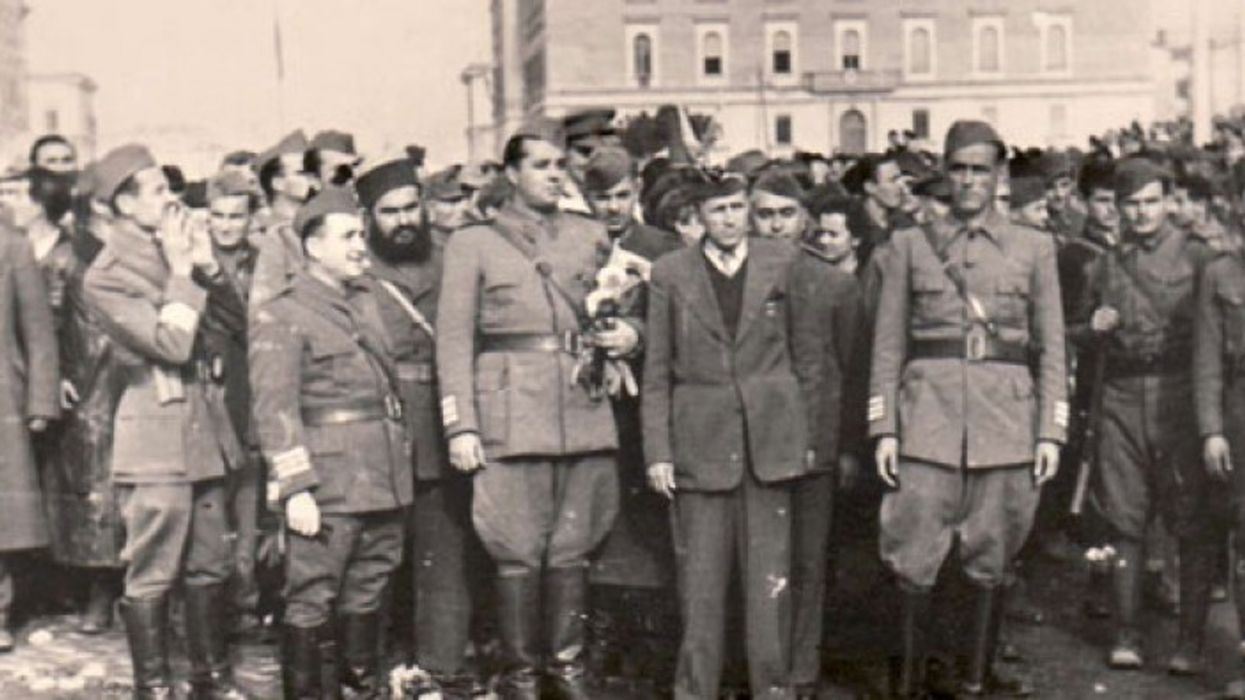
In that book I came across a picture of Hoxha and his men marching into Tirana that day - November 28, 1944 - after the Germans had left. Listed with Hoxha in the photo were: Koçi Xoxe, Myslim Peza, Omer Nishani, Mehmet Shehu, Baba Faja, Spiro Moisiu, Captain Marcus Lyon and, to my surprise, Captain Tom Stephan, identified only as the “US Liaison Officer.”
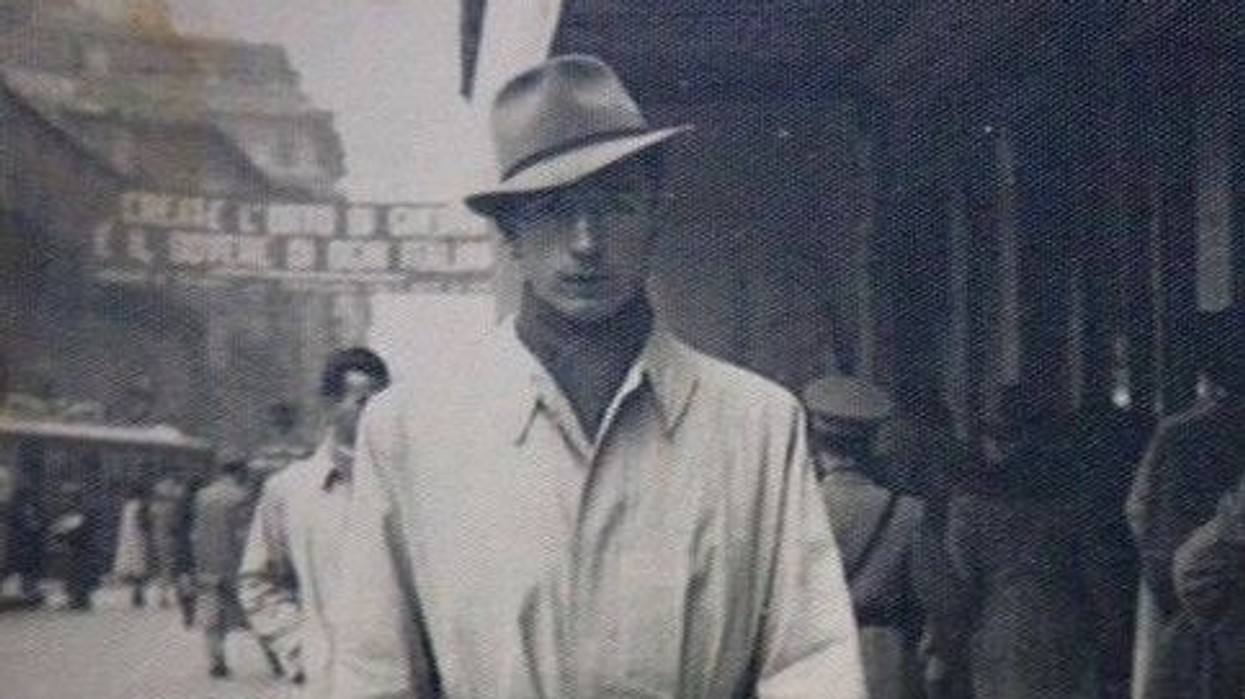
This immediately piqued my interest. Who was an American soldier with an Albanian-sounding name parading with Hoxha in Tirana in 1944? I did not know that there were any Americans in Albania during World War II. Nobody knew. However, here was an American army officer marching in Tirana with Hoxha.
How did this happen? And who was this Captain Tom Stefan?
I decided to find him. It took some time to find him because no one knew what happened to him in the years after the war. And when I finally found it, after a long search, it was too late. He was dead. However, I found and interviewed four OSS men who served with him in Odriçan, Helmes and Tirana. I also found and interviewed people who had met Stefan in Albania. There were also numerous files and records of the OSS in Albania stored at the National Archives and Records Administration in College Park, Maryland.
Through recordings and messages, I realized that Tom Stefan had lived an extraordinary time in Albania by the side of Hoxha, a man who understood him better than anyone else. Stefan also met and befriended Omer Nishan, Myslim Peza, Mehmet Shehu and all other partisan leaders during the war. He also knew Koçi Xoxen, although he never trusted him, for strong reasons of his own.
It all started for Stefan when he became a member of the newly formed OSS (Office of Strategic Services), which was the wartime predecessor of the CIA, and was sent to Albania to gather intelligence for the Allies. The next thing he knew he was in Albania, in the house of his ancestors, they were related to Hoxha.
Unlike the British, the Americans were new to the practice of intelligence and espionage when World War II broke out. The OSS was formed only after the disaster of December 7, 1941, when the United States, caught off guard by the surprise Japanese attack on Pearl Harbor in Hawaii, entered the war.
General William Donovan, a World War I hero, was appointed head of the new intelligence agency. One of Donovan's first initiatives was to enlist immigrants and the sons of immigrants to train and return them to their countries of origin, gather intelligence, and fight with partisans behind enemy lines. These Americans would know the soil and language of their countries and would be able to engage and be effective.
Thus, young Greek-Americans were sent as OSS operatives to Greece; Italian-Americans in Italy, Polish-Americans in Poland, Franco-Americans in France, and Albanian-Americans, like Tom Stefani and others, in Albania.
Of the 35 OSS Americans who served in Albania, all but three or four could speak the Albanian language. In contrast, the British hardly had anyone who spoke the language fluently and had to rely on interpreters.
Although quite modest compared to the British efforts in Albania - 33 British soldiers lost their lives fighting in Albania - the fact that the Americans helped Hoxha and the partisans was previously unknown. What was also unknown was how Captain Tom Stefan was able to get so close to Hoxha.
At first it was clear to Stefan that the fighting should be left to the British SOE and the Long Range Desert Group (LRDG), while Stefan and the OSS would collect information on German troop movements, convoys and ammunition, so that Allied aircraft could be sent on bombing operations. This explains the relationship with Hoxha and winning his trust, which Stefani did.
This was extraordinary. Before the war, Stephen was just a young American trying to get ahead. He worked in an Albanian-owned restaurant while attending night school at a college. When war broke out, he joined the US Army and, because he spoke Albanian, found himself in OSS training for a mission behind enemy lines in Albania.
The other thing he learned when he was in Albania, in the home of his ancestors, was related to Hoxha.
The OSS mission in Albania was headed by Harry Fultz, who knew Albania well, having headed the Fultz School in Albania for ten years before the Italians intervened in 1933. Mehmet Shehu was one of his students. Ten years after leaving Albania, Fultz was recruited by the OSS.
Fultzi chose Stefani to lead the Albanian unit of the OSS because Stefani had Albanian roots. He was born in Boston and his parents were from Korça. Stefani was fluent in Albanian, the language his parents spoke at home. It was this dialect that Hoxha spoke.
The Allies were also concerned about the potential of Germany sending troops from Albania to Italy as reinforcements. The fighting in Italy was pretty intense and the reinforcements and the fighting would only get tougher. Better than that potential German reinforcements were busy in Albania
Fultz often clashed with the British because he was adamant that the Allies only help the partisans of the National Liberation Movement since they, unlike the Front or Legality, were the only resistance group fighting the Germans.
All evidence points to the fact that Balli collaborated and fought alongside the Germans - not against them - throughout the German occupation, while Legality largely stood aside. However, the British maintained contact with Balli and the Legality branch Abaz Kupi. Hoxha was deeply angered by this fact and was convinced that the British were plotting against him.
Hoxha took great pleasure in this behavior of the British and often played with the British against the Americans. There is evidence that Stephen became useful in this game. Hoxha in meetings would speak to Stefani in Albanian and, before an interpreter could translate, leave the British questioning what was said. Hoxha may not have liked Americans, even Albanian-Americans, but he hated the British. While at war against the German invaders, Hoxha also fought a war with Balli over the question of who would rule Albania after the war ended.
Tom Stefani met Hoxha in April 1944, after traveling inland from the Allied base "Panorama" (Seaview) in Karaburun. While other OSS agents went with Memhet Shehu or Myslim Peza, Stefani remained with Hoxha in the field for eight months, from April 1944 to November 1944, and then in Tirana. Showing how close Stefani was to Hoxha is the fact that Stefani was the only member of the allies invited by Hoxha to participate in the Përmet Congress at the end of May 1944.
This led to conflict with the British. Intelligence gathering was a competitive business between the Americans and the British, even though they were allies. Although the British had been in Albania long before the arrival of the Americans, because of Stephen, the Americans had the upper hand.
Again, in October 1944, just a few days before Tirana was liberated, Hoxha asked Stefani to address the partisans at the Berat conference. While the representatives of the newly arrived British and Russians spoke, Stefani was able to give his assessments in the Albanian language, which had a positive effect.
It was from Berat that Stefani wrote to his superiors in Washington on November 14 - three days before Tirana was liberated - stating openly that he wanted to play a role in determining the "future policy" towards Albania. It was something he had undoubtedly discussed with Hoxha.
Stefani wrote: "It was our good fortune to be with the commanders who will lead the country. I know each of them, even Hoxha himself, with their weaknesses, their strengths and their ideology. There is no other group that has been closer to the situation than our section".
The march on Tirana shortly after the rally in Berat may have been the highlight of Stefan's career - even his life. Photos show him in the parade. Other photos show him on the tribune in front of the Dajti Hotel with Hoxha and other partisan leaders.
However, things changed very quickly. In Tirana, Stefani began to meet people, mostly Ball sympathizers, who lived in fear of the victory of communism in Albania, which was natural for them. The infamous Koçi Xoxe was appointed head of the Ministry of the Interior and the arrests began. Ballistas and suspected Ball sympathizers disappeared. The forehead was the enemy. Balli had supported the Germans. There were trials and executions. Families were destroyed. Houses were destroyed and property confiscated. Stefani reported this to Fultz and to Washington, and Hoxha did not like this.
Stefani became more and more critical of Hoxha. Meanwhile, he met Lulu Vrioni in Tirana and fell in love with her. Lulu was from the prosperous, well-known and respected Vrio family, which was related to Balli. Her brother was arrested as he had been a member of the Ball. Her uncle, Qemali, was in prison as a war criminal. Her parents were under surveillance.
Stefani secretly married Lulu in Tirana at the beginning of 1946, which angered Hoxha even more. Stefani then successfully smuggled Lulu out of Tirana on a US military plane that took them to Rome. Shortly after flying to the United States, they settled in Washington.
All this eventually led to the publication of my book "OSS in the Second World War in Albania". Its subtitle is: "Secret operations and cooperation with communist partisans". This book was translated into Albanian by Xhevdet Shehu.
It would be fitting if the story ended there. It would be like the ending of a romantic Hollywood movie. It would be even better if the US government knew of Stephen's potential importance in future relations between the two countries.
But things did not go well for Stefani. After the war the OSS was disbanded. He was discharged from military service. He wanted a job where he could use his knowledge of Albania and Albanian politics to use his country's aid and help Albania, perhaps as a diplomat or foreign service officer. But no one was interested, including the State Department. The war is over. Albania was old news. Nobody cared.
Lulu, because of her language skills, got a job with the Voice of America, while Stefani was placed in a lowly position at the Veterans Administration. He hated it. His marriage fell apart. He left Washington and wandered around the United States, often seeking out old friends from the OSS. He realized that they had all left the past behind and started a new life; Stefan couldn't. He was stuck in the past. It disappeared. No one knew where he was or what he was doing. It fell off the map. He ended up in Los Angeles where he suffered a stroke and died alone on the street on September 6, 1959. He was 42 years old. Unlike some British officers who served in Albania, Stefani did not write a book.
I didn't expect this ending when I started my search for Tom Stefan, but this is the ending I've come to know. I thought it was a shame that Stephen didn't live long enough to tell his story.
I am fortunate to have had the privilege of telling his story. /day/