

Turkish media and social networks have exploded with reactions about the song "Andromeda", with which the group Howl will represent Croatia in the Eurovision Song Contest 2026. Part of the public opinion in Turkey has seen in the lyrics and symbolism of the performance allusions to the Ottoman period in the Balkans, opening a debate on whether the song crosses the line between art and political message.
Lines such as: “When you light a candle, ask your grandmother / why she gave birth to daughters in fear”, “Our mothers were not born slaves” and “Our sons were not subjugated”, as well as the part mentioning “traitors” have been cited as problematic. In some media outlets and comments on social networks in Turkey, these lines are interpreted as references to historical experiences during Ottoman rule.
The visual elements of the performance have also caused reactions. In particular, the crosses and other Christian symbols on the faces and hands of the group members have been mentioned, which some Turkish audiences associate with historical accounts of women trying to protect themselves from violence and kidnappings.
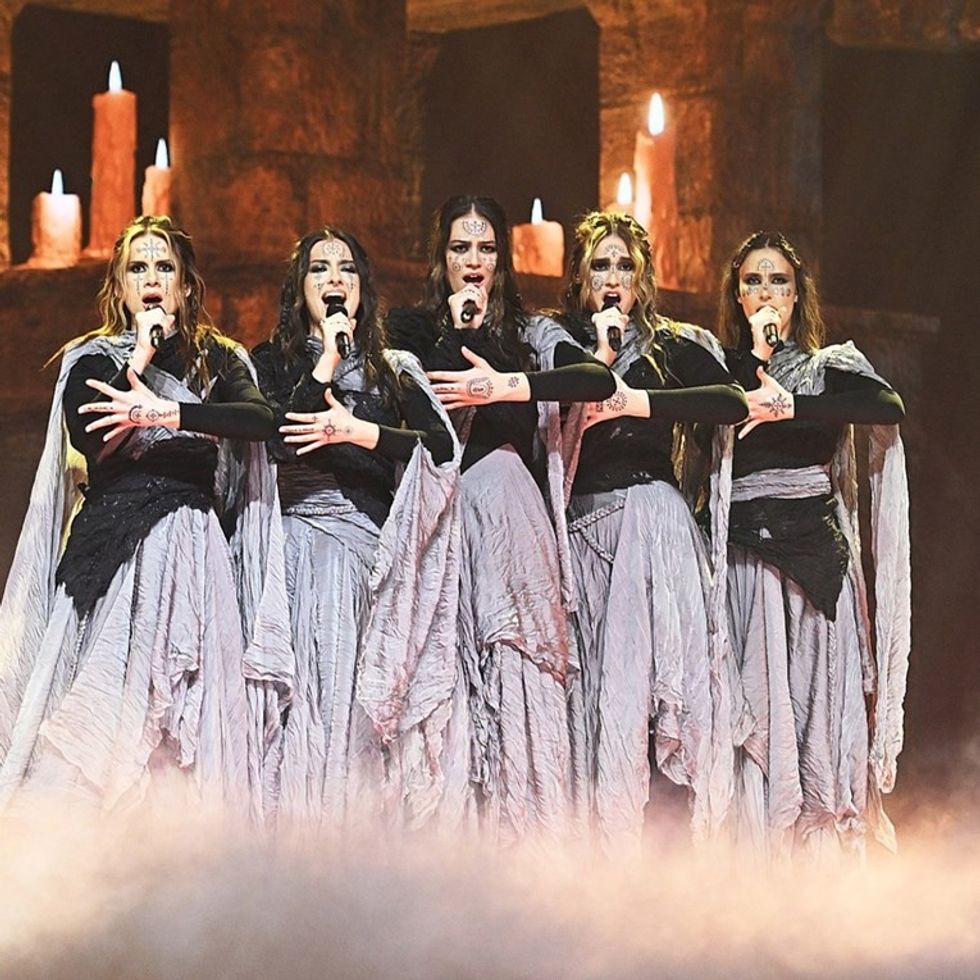 Photo: Renato Bađolica/Dario Njavro/HRT
However, the interpretations are not the same for everyone. The tattoos displayed in the performance are often related to the tradition of “sicanje”, an old custom of tattooing among the Catholic population of Bosnia and Herzegovina. This custom is usually seen as part of cultural and religious heritage, and not necessarily as a symbol of resistance to the Ottomans.
Various explanations have been given for this practice before. For example, a Bosnian woman, Mara Bojić, has stated that these tattoos were not a “shield against the Turks”, but part of the Catholic tradition. On the other hand, some scholars point out that in certain periods, this custom also took on additional meanings, such as preserving identity during Ottoman rule.
Precisely because of these different interpretations, a part of the Turkish public has seen the performance as more political than artistic. While from the Croatian perspective, it is considered an artistic treatment of historical memory, collective pain and motives of betrayal, without directly referring to today's Turkey.
- YouTube youtu.be
The Lelek group consists of Judita Štorga, Inka Večerina Perušić, Korina Olivija Rogić, Lara Brtan and Marina Ramljak. They are an ethno-pop formation that combines traditional motifs with modern sounds. Last year they participated in the national festival Dora with the song “The Soul of My Soul”, where they placed fourth, while this year they secured representation at Eurovision.
Croatia will be represented with "Andromeda" in the first semi-final of Eurovision on May 12 in Vienna. The lyrics of the song were written by Tomislav Roso, while the music was composed by Filip Lacković, Lazar Pajić and Zorja Pajić.
The whole situation has also reopened the discussion about the possible reaction of the European Broadcasting Union, which in the past has intervened when it has assessed that a song contains political messages. So far there are no signals that the group will be forced to change its performance, but it is clear that “Andromeda” has attracted international attention even before the start of the competition. /Telegraph/