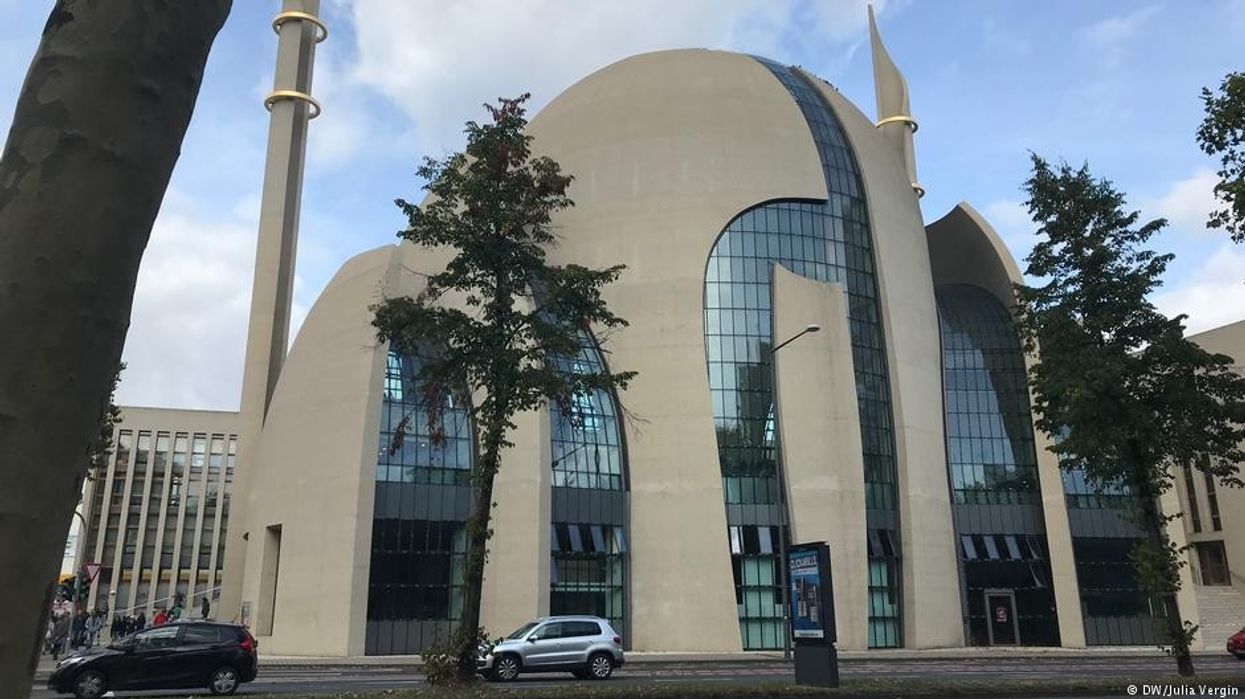
It seems surprising in a country that cares so much about statistics and loves order like Germany, that no one knows the exact number of mosques and prayer spaces. What are the reasons?
It is not known exactly how many associations, mosques or prayer spaces for Muslims there are in Germany. At a time when many argue about the "large number of mosques" or "the ever-increasing number of mosques".
There are only estimates for the number of mosques and prayer spaces in Germany.
Islamic scholar Michael Blume explains a simple legal reason for this. "According to the German constitution there is no registration obligation for religious communities.
"Which means that if a religion or religious organization is not a registered legal entity, then it is not counted statistically."
Mosques like temples
Also in Germany, as for mosques, it is not even known how many Buddhist temples there are in Germany, the researcher compares.
Mosques in Germany are registered under association law and it is up to them whether or not to join larger associations such as Ditib or to be completely independent.
The opposite of this are the large churches. They are registered in the "yearbook" of the German Statistical Office, just like the Jewish communities.
The church and the Jewish community have legal clerical agreements with the state.
Meanwhile, in the statistics book, there is not a single word about Islam, mosques or Muslims. On the other hand, the Catholic Church counts not only in Germany, but in the whole world, how many churches there are.
2500, 2600, 2700
And yet figures are mentioned for mosques in Germany. The Central Council of Muslims announced in early October that there are about 2500 mosques and religious spaces in Germany.
Most of them are prayer rooms in the back yards of the buildings, about 900 are part of the public space.
Islam is much less hierarchically organized than other monotheistic religions.
It is enough for a few religious friends to arrange a room, like in Berlin, the feminist lawyer "liberal mosque".
The Scientific Service of the Bundestag dealt with the topic of financing mosques until May of this year.
And he encountered the problem of concrete numbers of mosques. Clarification is difficult, because there are no official statistics on their number.
"We estimate that there are approximately 2600 to 2700 mosques of various shapes."
Bundestag experts have summarized the calculations and have come to the conclusion that the figures range from 2350-2750 mosques.
Even the number of Muslims in Germany is said to reach 4,4 to 4,7 million people. And only a minority, about 15-30%, is organized in associations.
Financing from abroad
Before this problem, Islamic researcher Michael Blume also gives an answer to the question: Why are the few representative mosques in Germany financed from abroad, from Turkey or Saudi Arabia.
"The big problem of Islamic communities is that they don't have enough funds."
This is because very few Muslims see themselves as members of mosque communities. Donations can be collected to build a small mosque. But when it comes to financing imams and working with young people, the situation worsens, the money is lacking. "That's why Turkey is so powerful," says the researcher. The Turkish state pays the imams.
It does not reflect the diversity within Muslims
Michal Blume, who published the scholarly book "Islam in Crisis" last year, sees these inaccuracies in the statistical inclusion of Muslims and mosques as problematic.
"We don't even know exactly how many Muslims there are in the country, because it's not counted. We know roughly the number of people of Muslim origin who come from predominantly Muslim countries. But a part of them, a growing part, says: I'm not religious, I don't have much to do with religion. There are others who say: Yes, I'm Muslim, but I'm not affiliated with any mosque or association. And a very small part joins mosque associations."
The researcher proposes that the federation and the states create opportunities for researchers to do detailed studies on this.
So no one knows the exact number of mosques. But this fall the Islamic Conference will meet for the first time since the Bundestag elections in 2017. Finding a deal on better statistical inclusion is expected to be a topic to be addressed. /dw/