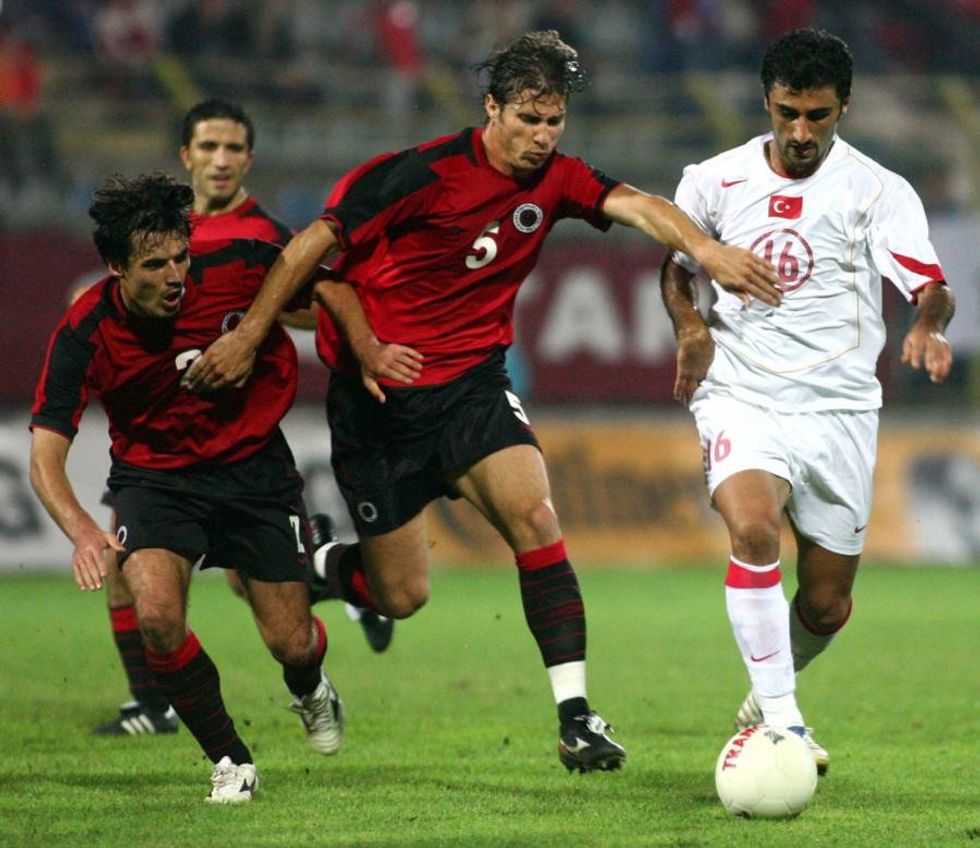

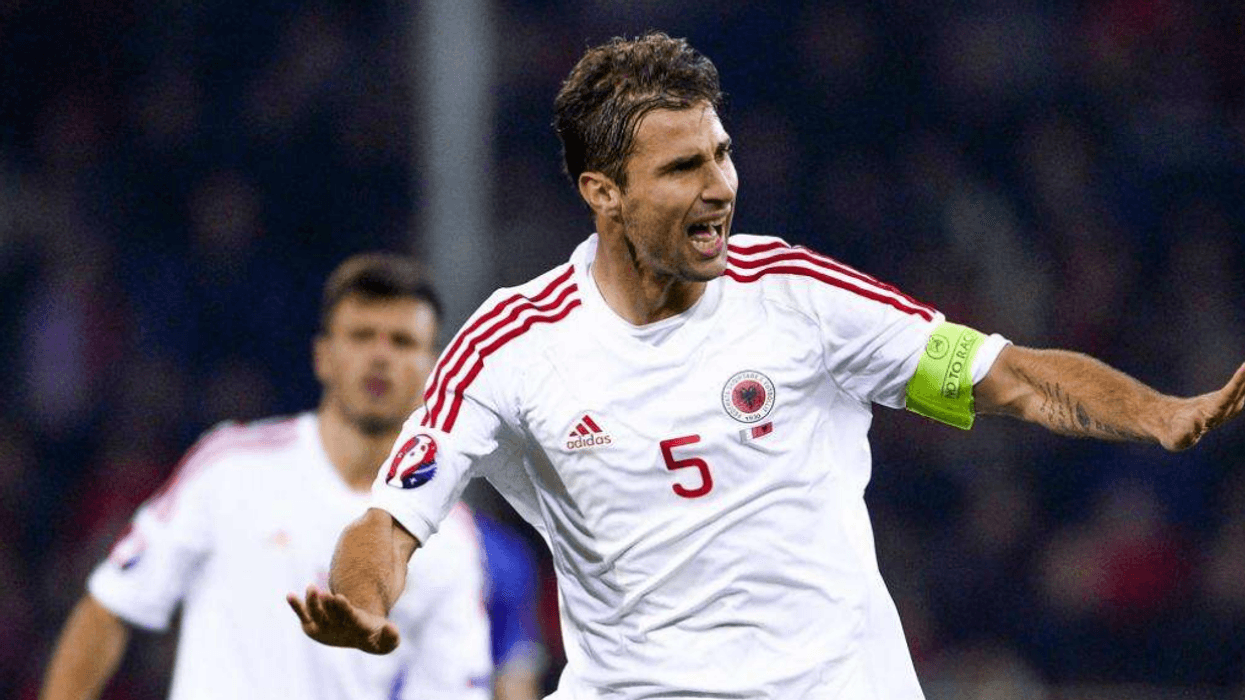
In a long interview for So Foot, Lorik Cana has told about the time he is passing after his retirement from football and about the Representative of Kosovo and the National Team of Albania.
The legendary captain said that it is the dream of the Albanian people that the union of Kosovo with Albania takes place and that sport has always been the best ambassador of the Albanian nation.
You ended your career at the end of Euro 2016. How have you spent your life in these three years?
I traveled, spent time with my family and relatives. I benefited a little more from gastronomy (laughs). The first year was relaxing, I gained weight. Then I got my first qualification as a sports director. Now, for two years, I have been working on the project of the foundation that is close to my heart, to promote sports for children in Albania and Kosovo. At the end of 2019, there will be about 1000 children who will be part of the foundation's program. The work is, for example, to build mini-sports fields in public spaces and accompany children in sports activities with educators. We started in Tirana and now we are spreading more gradually.
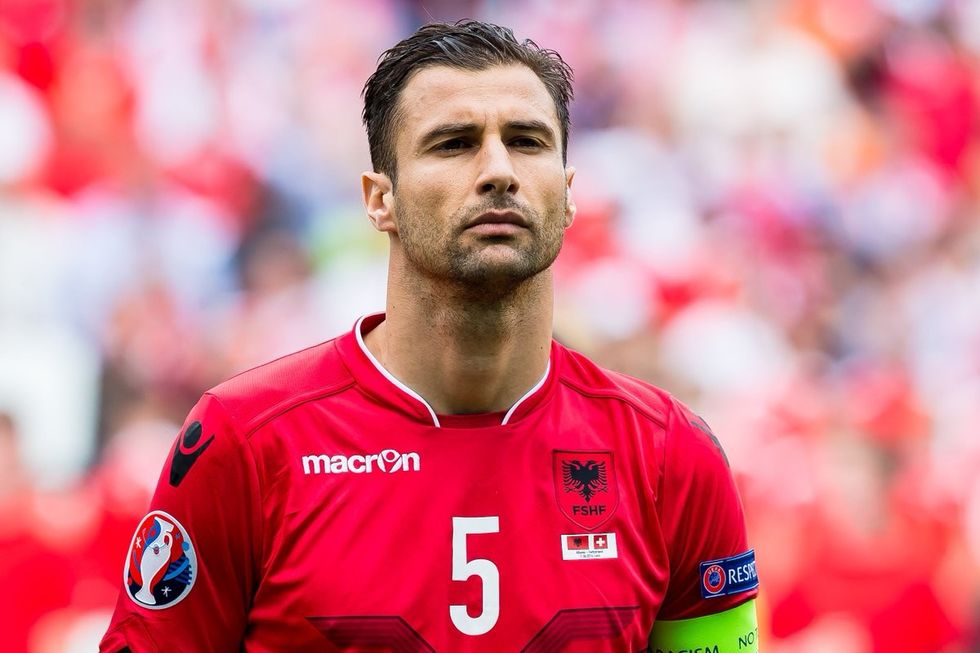
In 2009, you spoke in an interview for So Foot for your passion for the Illyrian civilization and the desire to one day dedicate a foundation to archaeological research in Kosovo...
My foundation rests on two big pillars. The first is of course sports. The rest is archaeological heritage. We need to find partnerships with ministries and big organizations to promote it, which has not been done much in recent years... In Albania, the unemployment rate is quite high. The population is very young, especially in Kosovo. And young people see emigration to rich countries as the only way to help their families. Therefore, there are many challenges for Albania and the aspect of national heritage does not yet have the importance it deserves.
The best moments of your career are with the Albanian national team?
The biggest joys and disappointments are with the national team. Losses and not one in particular. You can't live up to people's expectations of you, you feel guilty. After the losses, it was extremely difficult for me to sleep for 2-3 nights, even when I was in the club, even when I knew that the opponent was stronger.
Do you remember the first collection? In June 2003, in Geneva, Switzerland-Albania. Switzerland, the place where you grew up…
It was very special. I received my first invitation to a friendly in 2002. In that year, I joined PSG's professional team, but played most of the matches with the reserve team, managed by Antoine Kumbare, who led me to PSG. I still remember a match at the Camp des Loges where Luis Fernandez made fun of Albania taking a player from the PSG B team to play with the A team. It was a joke that complimented me more than anything else. So in June 2003, I came on to play in the second half of the match in Switzerland. The match was played about 50 kilometers from where I grew up.
Why was it so clear in your mind that you would play for Albania, knowing that Raymond Domenech had contacted you to integrate with France?
My grandfather was one of those of the first generation who demanded the independence of Kosovo in 1990. One of my father's uncles, a writer and journalist, was one of the biggest activists of the Albanian cause in Kosovo. My father was a football player from Pristina and represented the Albanian minority in the former Yugoslavia through football. We experienced this conflict in 1990. In my heart, since I was a child, I felt the need and desire to do something for my country.
Did you imagine at the age of 20 that one day you would represent Albania in the final stage of a major tournament?
Honestly, for many years, qualifying for a major tournament was an almost unattainable dream. When I arrived at the team, we had great players who played in the Bundesliga, but we didn't manage to get the best from that generation. I remember a victory over Greece, who had just been declared European Champions, 2-1 in Albania. From 2006 to 2012, we experienced ups and downs. Then, an Italian coach Gianni De Biasi came. He worked hard on and off the field to give Albanians who were not born in Albania the opportunity to represent their nation. Albanians have always played in big clubs, but some of them represented Germany, others Switzerland, or Belgium, others Greece and Turkey... For the first time, we managed to use this key moment in history to bring all Albanians born or originated in the national team, and we managed, with a wider number of players available, to qualify for the European.
Did you join this banner call?
Of course. It was the case of the Xhaka brothers. I remember my younger brother, Granit, who plays for Arsenal, called me because he wanted to play for the national team. At that time, FIFA did not give permission because he did not have an Albanian passport. One of the first players to play for Albania after playing for Switzerland's youth team was Basha, who played for many years in Serie A, including with teams such as Torino.
On the road to Euro 2016, there is a special moment, your trip to Serbia on October 14, 2014. A drone arrives over the field with the flag of Greater Albania. Serbian fans take to the field to fight, one of them hits one of your teammates in the head with a bench. You jump at them. And you, the Albanian players, are forced to return to the locker room to protect yourself...
We started the qualifying campaign by beating Portugal, in what remains Portugal's only defeat since their Euro 2016 win. We went into that game in good group positions. We had expected the hostility in Serbia since the moment of the draw, but at no point did we think that we would be in physical danger on a football field. The Serbian fans attacked us on the pitch, it was almost unreal.
What was going through your mind in those moments? Were you scared?
Not at all. At that moment it reacts naturally. We had a cooperation between us so great that if someone attacked one of your brothers, you had a reflex to protect him. Only later did we realize it could have been worse. Fortunately, there were no serious injuries.
In Group A of Euro 2016, the draw put you together with Switzerland, where you grew up, and France, where you lived for a large part of your career…
In the first match of the European Championship, Albania-Switzerland, five footballers of Switzerland's 11 were of Albanian origin (Granit Xhaka, Valon Behrami, Admir Mehmedi, Blerim Xhemajli and Xherdan Shaqiri). We spoke Albanian together, not on the field, you don't speak much there, but before the match.
In the 36th minute, you were punished with a red card. At that moment, did you know immediately that you were going to be sent off and banned for the game against France?
If the ref buzzed for them, I knew I was out. As Seferovic was pulling my shirt down, I had a small hope that he was rushing for us. When I slipped, I had 2 hundredths of a second to make the decision, try to get up knowing he would be alone to make it 2-0, or somehow stop the ball before it entered the box. I made the decision to stop the ball… and it almost worked, as near the end we came very close to equalizing.
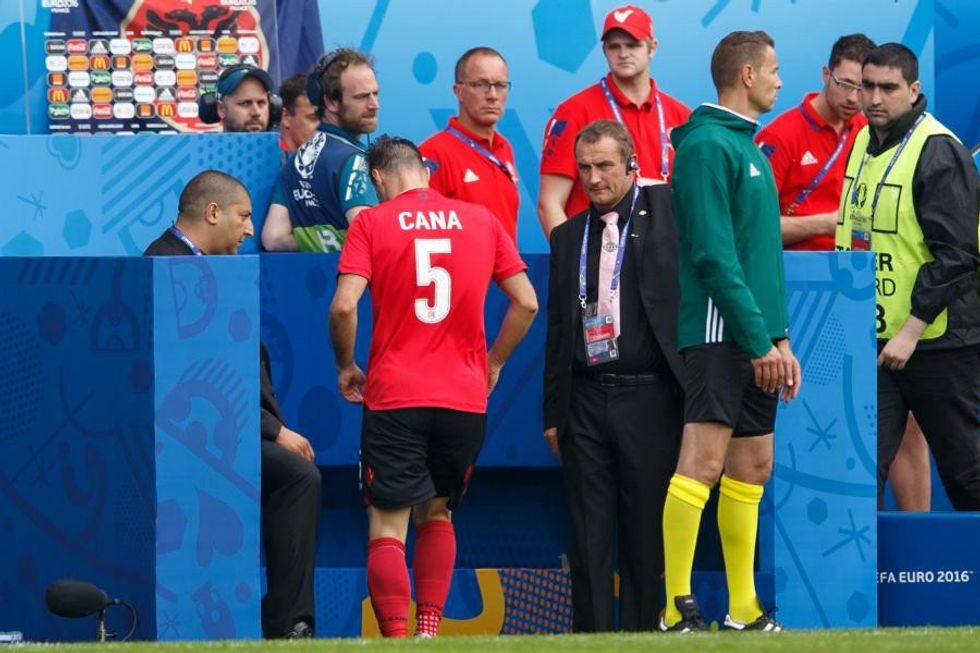
Despite a win over Romania, your journey was halted in the groups. Do you have any regrets?
The only regret was the way we started the match against Switzerland. We were under pressure during the first 20 minutes. Then we gave a great performance, in the next game, we held France to a draw until the extra minutes. Then we managed to win the match against Romania. I was very hopeful that we would finish in the top third, but it didn't help that we were in Group A. Then there was this Hungary-Portugal game where everyone ended up happy (3-3) as they they knew in advance which results qualified them.
Was Albania's participation in Euro 2016 an influence on the practice of football among young people in your country?
The majority of young people play football and follow football. Little by little there are also women who are doing such a thing. But in our country, the licensing aspect is not like in France, since access to the infrastructure is not affordable for everyone. In Albania, if you are going to be part of a team, you have to be integrated into an academy and most Albanian families cannot even afford to pay even 25 euros for their son to be part of the team... The success of the team Ours was based more on players who had grown up abroad, myself included, who had the opportunity to be trained on good pitches and by super coaches. The great challenge of our country is to give the best possible opportunity to young people born in Albania, Kosovo or North Macedonia, to try to practice football when they grow up.
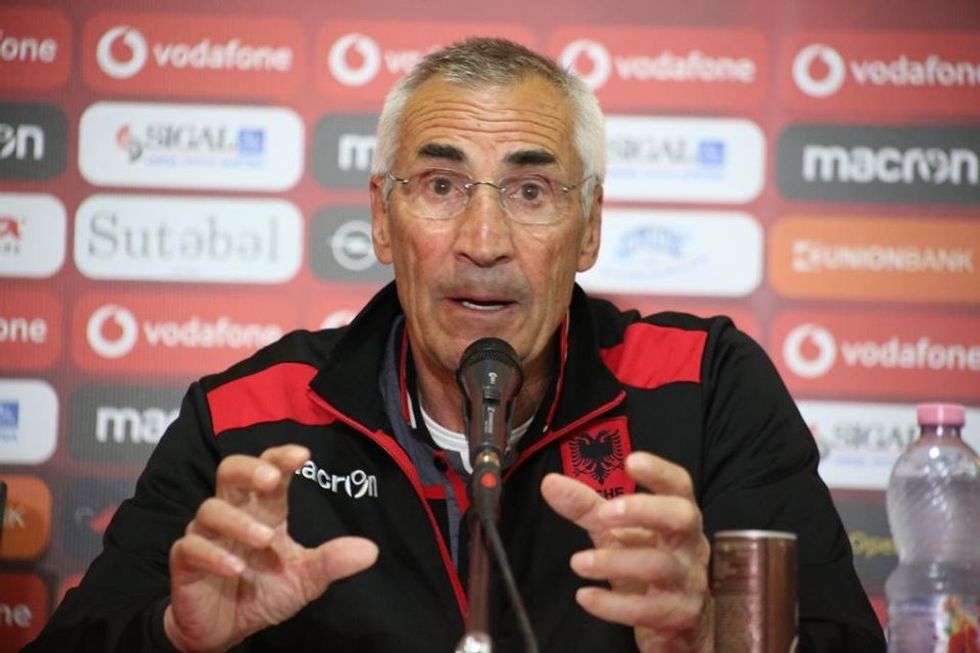
Edoardo Reja is the new coach of Albania since April. How are you seeing it?
He is an Italian coach who has a lot of experience, not so far from Italy, but Albania is very focused towards Italy. I knew him when I played at Lazio. I thought he has changed in terms of relationships. He has understood that the atmosphere in the national team is very important, the players should not feel like they are stuck in a circle on the green field. The players need to meet their families and feel the support of the public. In terms of sports, Albania is not seeing its best moment. It never caught on with Christian Panucci after the European and we can't immediately ask for big results from the new players arriving now.
You said in another interview this week that the shortcomings of the current generations in Albania are explained in particular by the distribution of talents between Albania, Kosovo and North Macedonia...
We knew for many years that Albanians originating from Kosovo would naturally return to Kosovo. Now we don't have a national team of Albania, but two teams representing two countries: Albania and Kosovo. And the biggest talents currently play for Kosovo. In the future, we will have a lot of difficulty to find generations capable of claiming European qualification again. And if one day Kosovo qualifies for a major tournament, Albania will be indisputably behind Kosovo. In addition, in the Albanian team that qualified for Euro 2016, half of the players were originally from Kosovo.
You too, since your family is originally from Gjakova, in Kosovo. Do you think that one day, in the distant future, you will see a selection of Greater Albania, if Albania and Kosovo are reunited?
I don't know. Now they are working to consolidate Kosovo in the international arena, where it is already recognized by about 100 countries, but it is not yet a member of the United Nations. Kosovo must find an agreement with Serbia so that they are mutually recognized as two independent states and that the people of Kosovo can travel freely in Kosovo. For us Albanians, national unification is our dream, but before that we have many things to fix. What is certain is that sport has always been the best ambassador of the Albanian nation. /Telegrafi/